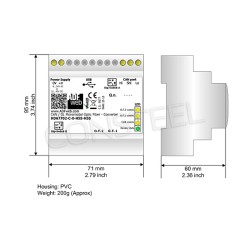
Industrial RS232, RS422 and RS485 to Fiber Converters
RS232, RS422 and RS485 to fiber converters enable reliable long-distance data transmission between serial devices using fiber optic infrastructure. These devices convert electrical signals from standard serial ports into optical signals, allowing communication over distances of up to 120 kilometers. This technology provides enhanced electromagnetic immunity (EMI) and radio frequency interference (RFI) resistance, which is crucial in industrial environments with high electrical noise and potential signal disruption.
In addition to improved transmission stability, fiber communication also provides complete galvanic isolation between devices, preventing damage caused by voltage surges, ground loops, and differences in electrical potential. This makes RS485 to fiber converters a valuable solution for critical applications where communication reliability and safety are paramount. By replacing copper cabling with fiber optics, users gain greater protection against lightning strikes, transient voltages, and harsh ambient conditions.
Applications in Industrial and Mission-Critical Systems
RS232 and RS485 to fiber converters are widely used in industrial automation, process control, and SCADA systems, especially where communication must span long distances or pass through electromagnetically noisy environments. They are also employed in monitoring and control networks for power stations, water treatment plants, gas utilities, and transportation infrastructure such as railways, airports, and metro systems. In such environments, communication between remote devices like sensors, PLCs, and controllers must remain stable and interference-free.
These converters are suitable for both new installations and retrofitting of existing systems, where traditional copper-based RS485 links are prone to failure or subject to regulatory safety limitations. By integrating serial to fiber converters, engineers can build robust networks with extended reach, lower maintenance costs, and higher immunity to industrial noise.
Key Features and Technical Capabilities
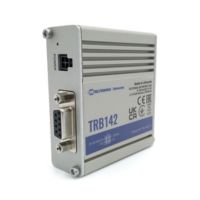
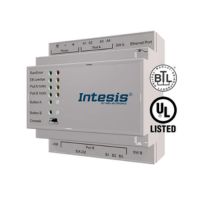
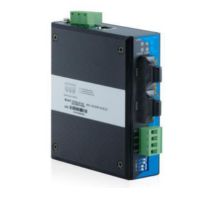
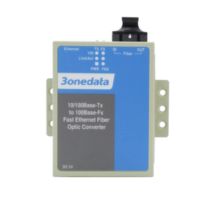
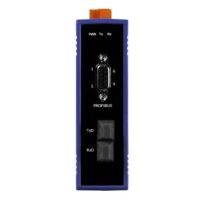
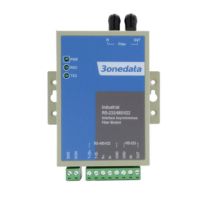
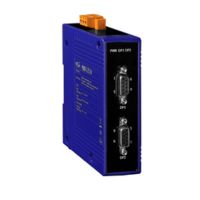
Depending on the interface type, each converter can support one RS232 device or up to 16 RS485 devices. RS232 ports typically use DB9 connectors, while RS485 ports use screw terminal blocks. On the fiber side, users can choose between SC/UPC, ST/UPC, LC connectors or models with SFP slots for modular transceivers. This allows for flexible adaptation to various network types and fiber topologies.
Supported fiber modes include single-mode, multi-mode, and WDM (single-fiber) transmission. Advanced versions of these converters support point-to-point communication, single-ring, or redundant dual-ring topologies, which allow network designers to ensure uninterrupted operation even in the event of a fiber cut or device failure. These features are especially useful in high-availability applications where network redundancy is a key requirement.
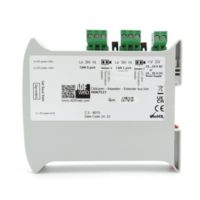
Select models from ADFweb offer enhanced diagnostics via Modbus RTU, allowing users to monitor device status, DIO states, and communication metrics in real time. Some models also include an integrated I/O module for transmitting digital inputs and outputs (DI/DO) over fiber, making it possible to extend not only serial data but also binary signals across isolated locations. All converters are protocol-transparent, meaning they do not alter or interpret the serial data in any way. This ensures compatibility with any master-slave communication protocols, including Modbus, Profibus, DNP3, and others.
Rugged Design, Compliance and Deployment
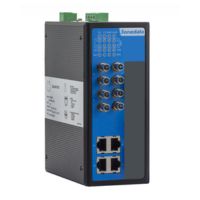
Industrial fiber converters are engineered to perform in demanding conditions. Housing options include DIN rail-mountable enclosures and rack-mountable units (4-port or 8-port RS485 versions), offering flexibility for centralized or distributed installations. Depending on the model, the operating temperature range may reach -40°C to +75°C, ensuring reliable performance in both indoor and outdoor environments.
All models conform to relevant industrial standards, including EMI, EMS, IEC, CE, and more, verifying resistance to vibration, shocks, power surges, and extreme temperatures. Their long operational life and low failure rate make them a preferred choice for systems where uptime and data integrity are critical.
Explore our selection of RS232 and RS485 to fiber converters and find the model that fits your needs. If you’re unsure which product to choose, or if you require assistance with your project, please contact our team — our technical experts will be happy to advise you and help configure the right solution for your application.