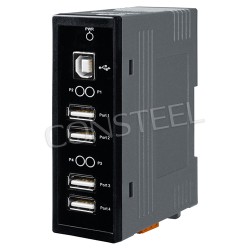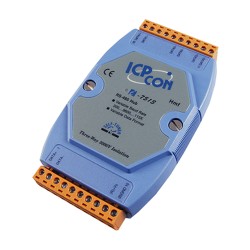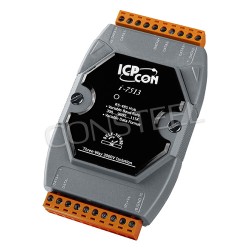






























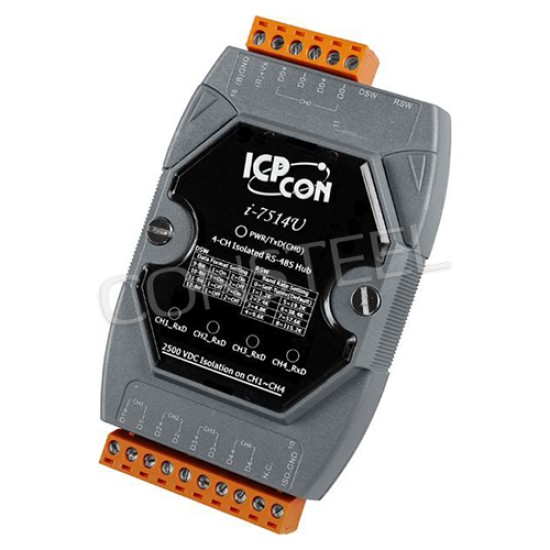
I-7514U CR - 4-port active RS-485 HUB
I-7514U is 4-port active RS-485 HUB, temp. -25…+75°C, DIN rail, power 10–30VDC, cert CE/UL.
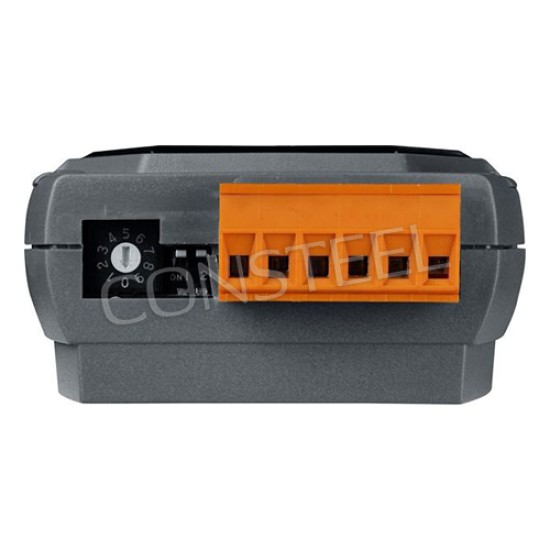


- Stock: 2-3 weeks
- Brand: ICPDAS
- Model: I-7514U CR
Full design package: User manual, CE declaration, CAD, PDF, certificates and test reports
If you're preparing technical documentation or an installation design, you can receive a complete set of design materials for this model. This is a quick way to gather the required documents for audits, acceptance, or project documentation.
- Device User Manual
- CE Declaration of Conformity (EU Declaration of Conformity)
- Mechanical Drawings – CAD (STEP/DWG) or high-quality PDF
- Additional Certificates and Test Reports (if available for the model)
Industrial Isolated 4-Channel Active RS-485 Hub. Model I-7514U by ICP-DAS.
RS-485 Active Hub
The I-7514U is an active RS-485 hub with 4 output channels and one input channel. Each output channel is equipped with an individual driver, ensuring independent operation. Data sent to the input channel is simultaneously forwarded to all four output channels. This allows the same information to be distributed simultaneously to multiple devices connected to the outputs. This solution makes the RS-485 network more flexible and efficient, enabling better data transmission management in industrial systems.
Engineering note: true RS-485 star wiring (segmented bus)
The I-7514U is a true RS-485 star wiring hub: one input (master side) is replicated to four isolated segments. Each channel has an independent RS-485 driver, which helps prevent a single bad segment (noise, reflections, wiring fault) from destabilizing the whole network. This is a practical way to split long or complex RS-485 installations into shorter, easier-to-diagnose branches.
For reference transfer distances depend on the cable: with Belden 9841 (2-pair twisted) the typical maximum is 1,200 m at 9.6 kbps and 400 m at 115.2 kbps (other cables may change the achievable distance).
The design includes 4 kV ESD protection and 2500 VDC isolation on CH1~CH4 (isolation side), which is useful in industrial cabinets where potential differences and EMC events can disrupt RS-485.
Splitter
Data from the master input is transmitted to all four RS-485 slave channels, allowing information to be distributed simultaneously to multiple devices connected to these channels. However, data from the slave channels is only sent back to the master input, meaning communication is unidirectional from the slave channels to the master. This design reduces the risk of interference between individual slave channels since each slave channel operates independently and does not affect the others. As a result, RS-485 networks become more resistant to interference and more reliable, which is crucial in industrial applications where stability and continuous communication are essential.
Commissioning: baud rate & data format (Self-Tuner vs Fixed)
The I-7514U provides two baud rate modes. Self-Tuner mode supports multiple baud rates and multiple data formats and is designed like the I-7510 series. The supported range is 300 ~ 115200 bps. If you need better signal quality on long, lossy, or electrically noisy lines, use Fixed baud rate mode, which supports 1200 ~ 115200 bps.
In Fixed mode, the rotary switch (RSW) selects the speed: 0 = Self-Tuner (Default), and fixed positions map to: 1=1200, 2=2400, 3=4800, 4=9600, 5=19.2k, 6=38.4k, 7=57.6k, 8=115.2k.
Data format in Fixed mode is controlled by DSW and can be 9 / 10 / 11 / 12 bits. Factory default is 10 bits (1 start, 8 data, no parity, 1 stop). If you use the I-7514U with I-7000 series modules, keep the default (I-7000 modules have a fixed 10-bit data format).
Baud Rate Configuration
The I-7514U offers two baud rate configuration modes: the Self-Tuner mode and the Fixed Baud Rate mode. The Self-Tuner mode supports various baud rates and data formats, operating similarly to the I-7513 and I-7510 models. The Fixed Baud Rate mode ensures better data transmission quality over long, degraded lines or in environments with electrical interference.
Wiring & termination: per-channel 120 Ω control
In critical environments, signal reflections can cause CRC errors, retries, and random timeouts. The I-7514U includes a 120 Ω termination resistor for each channel selectable by jumper (default disabled). Enable termination only where a given segment is physically at the end of its RS-485 line; avoid over-terminating short branches.
The unit uses removable terminal blocks (10-pin + 6-pin). In star installations, treat each CH1~CH4 output as its own segment with consistent polarity (Data+ / Data-) clearly labeled end-to-end.
RS-485 Short Circuit Protection
The short circuit protection feature can automatically disable a faulty channel, protecting the communication system. If a connected RS-485 device fails, the faulty channel will be isolated to ensure the normal operation of the remaining devices.
Fault isolation: what the short-circuit protection really buys you
If one branch is shorted or a connected node fails electrically, the I-7514U can shut off the breakdown channel and isolate it so other branches remain operational. In industrial networks this reduces downtime and makes troubleshooting faster (you can focus on the affected segment instead of the whole bus).
Termination Resistors
In certain critical environments, termination resistors may be necessary to prevent serial signal reflections. The I-7514U includes a selectable 120-ohm termination resistor for each channel, adjustable via a jumper (disabled by default).
LED Indicators
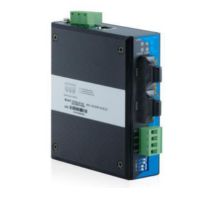
The I-7514U has 6 LED indicators signaling power status and network traffic. The TxD/RxD LED will blink when the device is transmitting or receiving data.
LED diagnostics: quick triage in the field
LED behavior is channel-specific: PWR (red) stays ON when power is present, TxD (green, CH0) flashes when data is being sent out, and RxD (orange, CH1~CH4) flashes when data is received on each output channel. If TxD flashes but a specific RxD stays dark, suspect wiring/polarity/termination or device-side issues on that segment.
Power input range is +10 ~ +30 VDC (non-isolated). Typical power consumption is 1.3 W. Operating temperature is specified as -25 °C ~ +75 °C (storage -30 °C ~ +80 °C), with 10% ~ 90% RH non-condensing.
Key Features of I-7514U
- Support for up to 4 RS-485 channels – an ideal solution for large industrial networks
- 2500 VDC isolation – protection against overvoltage and potential differences
- Self-Tuner and Fixed Baud Rate mode – flexible transmission configuration
- Short circuit protection – automatic isolation of faulty channels
- Built-in 120 Ω termination resistors – improved transmission quality over long distances
- Wide power supply range of 10-30 VDC – compatibility with various systems
- LED indicators – easy monitoring of device operation status
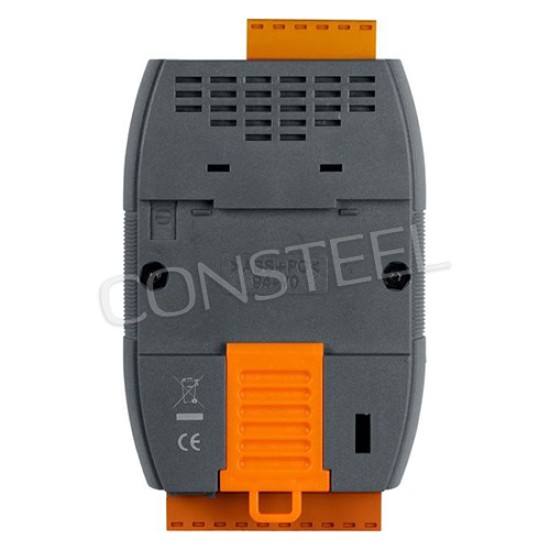
- DIN rail mounting – fast and convenient integration
- Maximum transmission range of 1200 m – stable communication over long distances
- Compatibility with SCADA, IoT, and Modbus systems – broad application
Thanks to these features, the I-7514U is an excellent solution for demanding industrial applications, ensuring high reliability and flexible configuration.
Practical Applications of I-7514U
The I-7514U is widely used in various industrial sectors where stable and interference-resistant RS-485 communication is required. With support for four independent channels and advanced security features, this device is chosen for control, monitoring, and infrastructure management systems.
1. Industrial Automation
In production plants, the I-7514U is used for communication between PLC controllers, sensors, and diagnostic systems. Thanks to its high resistance to interference, the device enables stable data transmission in harsh industrial environments. Typical applications include:
- Control and monitoring of production lines
- Integration of SCADA and IoT systems
- Managing a network of temperature, pressure, and humidity sensors
2. Transportation Systems and Road Infrastructure
In the transportation industry, stable and reliable data transmission is critical for safety. The I-7514U is used in traffic management systems, such as:
- Traffic light management
- Real-time vehicle monitoring systems
- Automated toll collection systems on highways
3. Smart Buildings and Energy Management Systems
The I-7514U is an ideal solution for energy management and building control systems, where communication with multiple devices over long distances is required. The device can be used in:
- Lighting management systems
- HVAC automation (heating, ventilation, air conditioning)
- Monitoring and controlling alarm systems
Technical Specifications
| Parameter | Value |
|---|---|
| Device Type | Active RS-485 Hub |
| Number of Channels | 4 |
| Isolation | 2500 VDC |
| Transmission Range | 400 m at 115.2 kbps, 1200 m at 9.6 kbps |
| Power Supply | 10-30 VDC |
Order Now!
Do you need a stable and secure RS-485 network? Choose I-7514U to ensure reliable communication, overvoltage protection, and the ability to expand your industrial infrastructure.
Our device guarantees high transmission stability and easy integration into any system. Contact us now to get more information or place an order!
Field-proven answers: star wiring, termination, Self-Tuner vs Fixed, data format, LEDs, and fault isolation.
? What is the I-7514U CR used for in RS-485 networks? ▾
I-7514U CR is a 4-channel isolated RS-485 active star wiring hub. One master input is replicated to four independent output segments, allowing you to split a bus into branches and improve stability and troubleshooting compared to a long single line.
? What baud rates does I-7514U CR support, and when should I use Fixed mode? ▾
Self-Tuner supports 300 ~ 115200 bps. Fixed supports 1200 ~ 115200 bps and is recommended for long/lossy lines or electrically noisy environments where you need more consistent signal quality.
? How do I set the Fixed baud rate on I-7514U CR (RSW positions)? ▾
RSW selects the speed: 0 = Self-Tuner (Default); fixed positions are 1=1200, 2=2400, 3=4800, 4=9600, 5=19.2k, 6=38.4k, 7=57.6k, 8=115.2k.
? What does 9/10/11/12-bit data format mean on I-7514U CR, and what is the default? ▾
In Fixed mode, DSW selects 9 / 10 / 11 / 12 bits. The factory default is 10 bits (1 start, 8 data, no parity, 1 stop). If you use I-7000 series modules, do not change the default because those modules require 10-bit format.
? When should I enable the 120 Ω termination resistor on I-7514U CR? ▾
Enable the per-channel 120 Ω termination only at the end of a given RS-485 segment (jumper selectable, default disabled). Over-termination can degrade the signal, especially on short branches.
? How can I quickly diagnose traffic issues using the LEDs on I-7514U CR? ▾
PWR (red) ON means power is present. TxD (green, CH0) flashes when data is sent out from the input side. RxD (orange, CH1~CH4) flashes when data is received on each output channel. If TxD flashes but a channel’s RxD does not, focus on that branch (polarity, wiring, termination, node power).
? What happens if one branch is shorted or a device fails on an RS-485 segment? ▾
The short-circuit protection can automatically shut off and isolate the faulty channel so the remaining channels continue operating, preventing a single failure from taking down the entire network.
? What are the reference transmission distances for I-7514U CR and what affects them most? ▾
With Belden 9841 cable: up to 1,200 m at 9.6 kbps and up to 400 m at 115.2 kbps. Cable type, grounding, EMC conditions, and termination quality can significantly change real-world results.
Warranty for I-7514U: 12 months
| General technical parameters | |
| Serial port | 5x RS-485 |
| Industrial grade | |
| Optoisolation | 2500VDC |
| Casing | Plastic |
| Operating temperature | -25°C to 75°C |
| Input voltage | 10~30VDC |
| Mount | DIN rail |