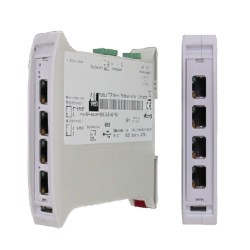
Industrial PROFINET to EtherCAT converters – what are they used for?
An industrial PROFINET to EtherCAT converter enables the integration
of control systems based on the PROFINET standard
with machines and devices communicating via the EtherCAT protocol.
These converters are used in industrial automation wherever a PLC or higher-level
control system operates on PROFINET,
while field devices, drives, or I/O modules use EtherCAT.
Using a converter allows both communication standards to be connected
without changing the existing system architecture.
The PROFINET to EtherCAT converter acts as a protocol gateway,
mapping process data from the PROFINET network
into the EtherCAT data structure in a stable and predictable way.
How does a PROFINET to EtherCAT converter work?
On the PROFINET side, the converter is seen as a standard network device
exchanging data with the PLC or control system.
On the EtherCAT side, it operates as a real-time communication node,
cyclically exchanging process data with EtherCAT devices.
PROFINET process data is mapped into the EtherCAT data area,
allowing the control system to:
- read signals from EtherCAT devices,
- send control commands and parameters,
- monitor alarm and diagnostic states,
- integrate EtherCAT devices with PLC and SCADA systems.
Industrial PROFINET to EtherCAT converters provide consistent data exchange,
even in installations with strict timing requirements
and a large number of connected devices.
Where are PROFINET to EtherCAT converters used?
The PROFINET to EtherCAT converter is used
in modern and upgraded industrial automation systems
where different communication standards must be combined.
-
Production lines and machinery: integration of EtherCAT devices
with central PLC controllers operating on PROFINET.
-
Retrofit and modernization projects: connecting EtherCAT-based machines
to existing PROFINET installations without rebuilding the system.
-
Process automation: communication between different network segments
in distributed control architectures.
-
Industrial plants: projects across Europe
where mixed PROFINET and EtherCAT environments are common.
Using protocol converters makes it possible to preserve the advantages
of both communication standards
while simplifying system integration across the entire facility.
What features should an industrial PROFINET to EtherCAT converter provide?
When selecting an industrial PROFINET to EtherCAT converter,
it is important to focus on features critical for reliable operation:
- deterministic process data mapping,
- full compatibility with PROFINET networks,
- support for cyclic EtherCAT communication,
- advanced diagnostics and error indication,
- industrial housing with DIN-rail mounting,
- reliable 24/7 continuous operation.
A properly selected PROFINET to EtherCAT converter
enables secure system integration,
shortens commissioning time,
and increases the flexibility of industrial automation infrastructure.