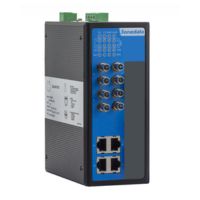
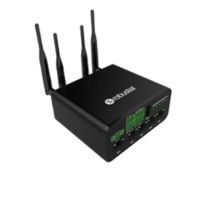
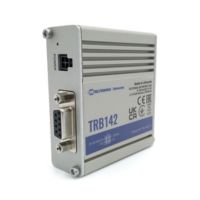
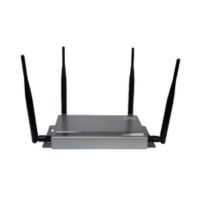
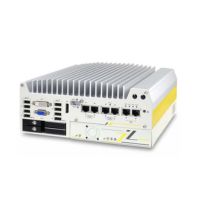
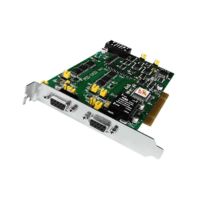
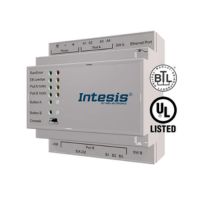
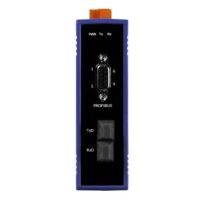
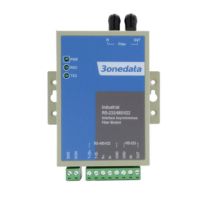
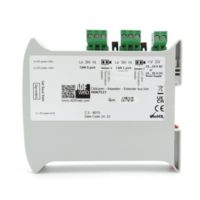
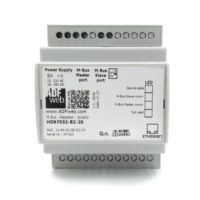
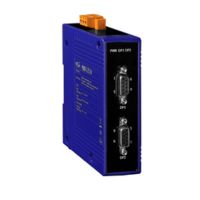
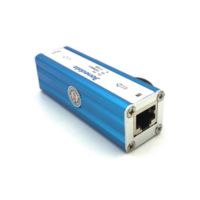
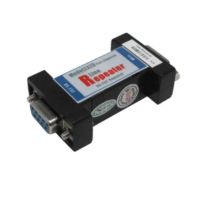
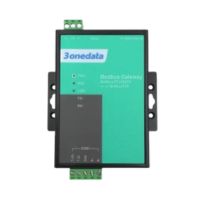
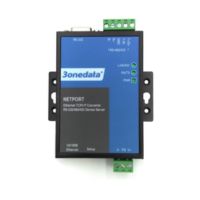
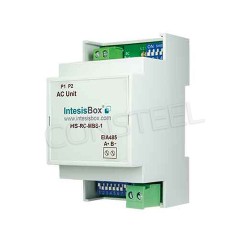
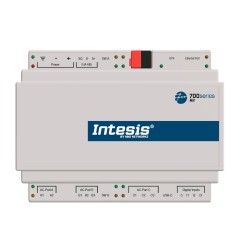
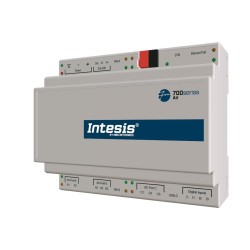
Hisense Modbus gateway is a proven way to connect Hisense air conditioning to building automation and
BMS/SCADA systems. In this category, we have gathered communication gateways that expose HVAC data via Modbus,
so the Hisense installation can be monitored and controlled from a single, central system.
Depending on your project requirements, you can choose solutions that operate via Modbus RTU (RS-485) or
Modbus TCP (Ethernet). This is a practical approach in facilities where stable communication, clear data exchange
with PLC/BMS, and fast commissioning are important—without rebuilding the entire infrastructure.
What do you gain by integrating Hisense via Modbus?
- Central BMS/SCADA supervision of Hisense air conditioning operation across the facility.
- Communication standardization – Modbus as a common language for HVAC and automation.
- Automation scenarios – schedules, zone logic, energy-saving operating modes.
- Faster diagnostics – easier maintenance and service thanks to monitoring statuses and alarms.
Integrating Hisense with BMS: when is Modbus the best choice?
Modbus is often chosen in building and industrial automation because it is simple to deploy, predictable, and easy to maintain.
If your facility uses a BMS, PLC controllers, or a SCADA system, Hisense Modbus integration lets you connect HVAC to the same
supervision layer as other technical installations. This gives operators a single dashboard for monitoring and control, while integrators can
implement automation logic quickly—without being locked into closed ecosystems.
In practice, these deployments require stable communication, a clear data map, and the ability to use standard tools on the BMS/PLC side.
The exact scope of available signals depends on the configuration and the interface used, but the goal is always the same:
full, centralized supervision of Hisense air conditioning operation in the building.
Modbus RTU or Modbus TCP – selecting the right option for your facility
The choice between Modbus RTU and Modbus TCP depends mainly on your infrastructure.
RTU (RS-485) is common in serial installations where simple wiring matters, while TCP is ideal for Ethernet networks
when you already have an established IP communication layer. For many integrators, the key is selecting a gateway that fits the
BMS/PLC communication layer without additional converters or workarounds.
Selecting a Hisense Modbus gateway for your project – fast and to the point
If you provide 3 details—whether you need Modbus RTU or Modbus TCP, what supervisory system you use (BMS/SCADA/PLC),
and the scale of the installation/zones—we will recommend the right model and the simplest integration approach.
Select Hisense Modbus with an expert
Quick tip
If your BMS runs over Ethernet, Modbus TCP is usually the simplest choice. If serial buses and RS-485 dominate in the facility,
Modbus RTU is the practical option.
FAQ – Hisense Modbus
What is a Hisense Modbus gateway used for?
It enables integration of Hisense air conditioning with BMS/SCADA or PLC via Modbus, allowing HVAC monitoring and control from the automation level.
Should I choose Modbus RTU or Modbus TCP?
RTU fits RS-485 and serial installations, while TCP fits Ethernet networks. The choice depends on your automation communication layer.
Is there also a KNX integration option in this category?
Yes. If your facility is based on KNX, you can use the INKNXHIS001R000 interface to integrate Hisense within the KNX bus.
How quickly can I select the right device?
You only need: RTU or TCP, what BMS/PLC you use, and the installation scale. We will recommend the model and the simplest integration approach.