



















How to integrate Apator meters with a BACnet network using ADFweb converters?
- Differences between M-Bus and BACnet – Why do they require a converter?
- How to choose an M-Bus to BACnet converter – Key ADFweb models
- How to increase the number of devices on the M-Bus line with ADFweb converters?
- Apator meters specifics in the context of integration
- How to connect and configure an ADFweb converter for an Apator meter?
- How to solve the issue of polling battery-powered Apator meters using Adfweb converters?
- How to deal with voltage drops on the line? Managing long distances
- Benefits of using the ADFweb solution for integrators
In the face of growing requirements for building certifications (such as LEED in the United States or the BREEAM rating system in Europe, including in Poland) and the need for accurate utility billing, integrating metering systems with a building management system (BMS) has become the standard. A key challenge in Polish realities is connecting popular meters from the Polish brand Apator, which mainly operate in the M-Bus protocol, with modern networks based on BACnet IP or BACnet MS/TP protocols.
The solution that helps connect building management systems based on the BACnet protocol with meters communicating in the M-Bus protocol—combining reliability and configuration flexibility—is the use of industrial converters from the Italian brand ADFweb. Below you will learn how to carry out the integration professionally and in a simple way, avoiding typical technical pitfalls and unnecessary stress.
Differences between M-Bus and BACnet – why do they require a converter?
Before we move on to configuration, it is necessary to understand the difference in the assumptions of both standards. How both protocols work and how they differ:
- M-Bus (Meter-Bus): This is a standard created specifically for meter reading. It is optimized for transmitting consumption data, e.g. energy or water, with minimal power consumption. In M-Bus, data is packaged into frames that contain a lot of information at once (e.g. date, time, errors, and several consumption registers).
- BACnet: This is an object-based protocol used mainly for controlling air conditioning, lighting, or fire protection systems. In a BACnet environment, each value from a meter (e.g. current thermal power) must exist as a separate object (most often an Analog Input).
Direct communication between them is not possible. ADFweb converters, e.g. from the HD67673 series, act as a “simultaneous interpreter” that polls Apator meters, breaks down their complex data frames, and exposes specific values as readable objects in the building network.
How to choose an M-Bus to BACnet converter – Key ADFweb models
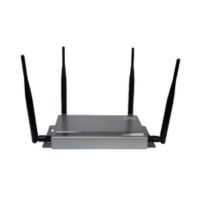
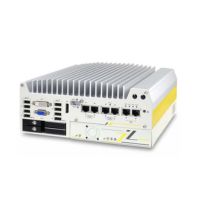
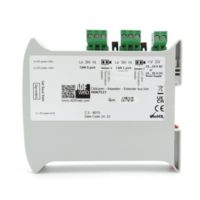
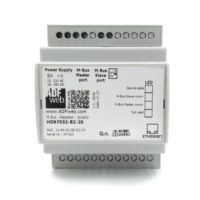
In the Consteel Electronics offer you will find a wide range of gateways/converters, which can be selected depending on the number of end devices or the existing network infrastructure of the facility. By using the models below from a given series, you can easily connect Apator meters to an existing infrastructure communicating via the BACnet protocol and deploy the system using free software available for download on our website.
- Converters from the HD67671 series (BACnet IP): these are the converters most often used in modern buildings, where integration takes place over a standard computer twisted pair (Ethernet).
- Converters from the HD67672 series (BACnet MS/TP): these converters are chosen for applications where a two-wire RS485 line is available and meters are integrated directly with local DDC (Direct Digital Control) controllers.
How to increase the number of devices on the M-Bus line with ADFweb converters?
In practice, the key factor when increasing the number of devices on the M-Bus line is the current output of the gateway, which must be absolutely matched to the number and type of connected meters—Apator in this case. In the M-Bus standard, each meter represents the so-called “1 unit load”, i.e. a unit current load on the line. This means that the maximum number of devices that can operate stably in one M-Bus segment is directly dependent on the power capabilities of the applied gateway or converter.
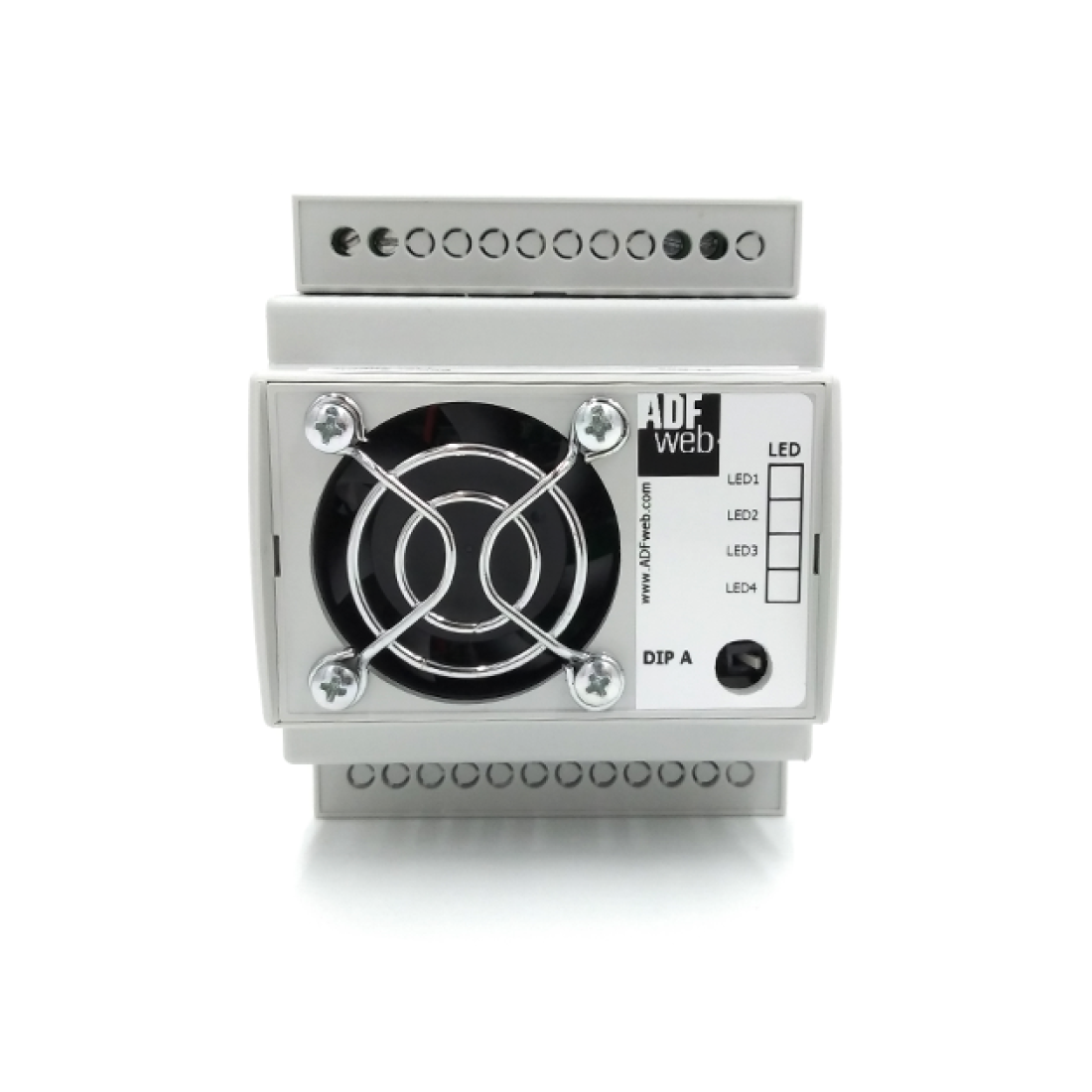
ADFweb converters are available in several variants that differ in the maximum number of supported unit loads, which makes it possible to precisely match the device to the scale of the installation—without the risk of bus overload, voltage drops, or communication issues. The offer includes, among others:
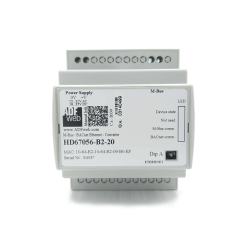
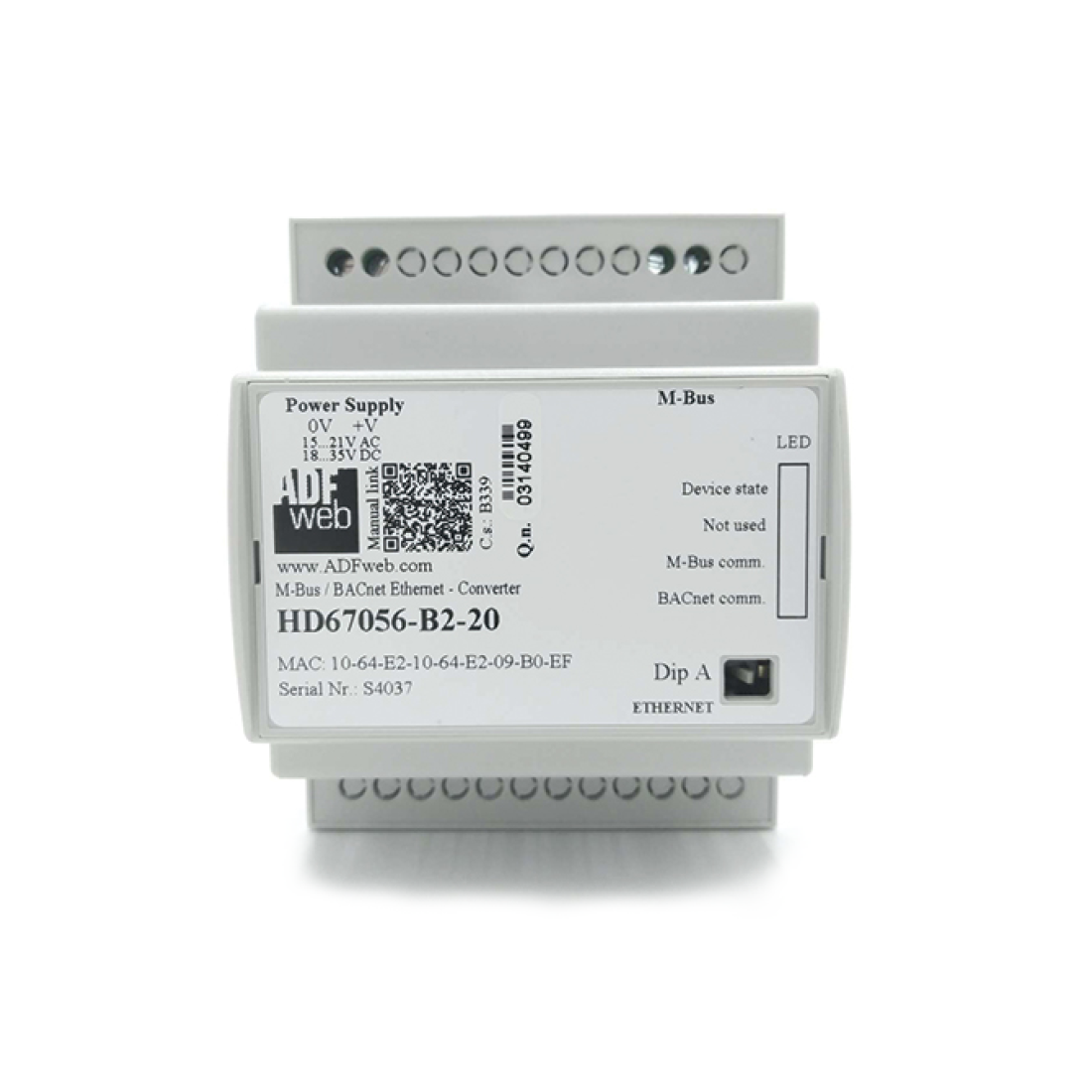
- Models supporting up to 20 M-Bus devices – recommended for small installations such as small heat substations, single metering cabinets, or local billing points. In such an environment, for example, the HD67056-B2-20 model will work well.
- Versions enabling connection of 40, 80, 160, and even up to 250 M-Bus devices – intended for large office buildings, industrial plants, shopping centers, or distributed metering systems where high scalability and stable operation are required. For such an extensive network, an excellent model will be HD67056-B2-250.
Thanks to this, scaling an M-Bus line using ADFweb converters is not about compromises, but about consciously selecting a gateway for the real needs of the installation—both at the design stage and during later system expansion.
Apator meters specifics in the context of integration
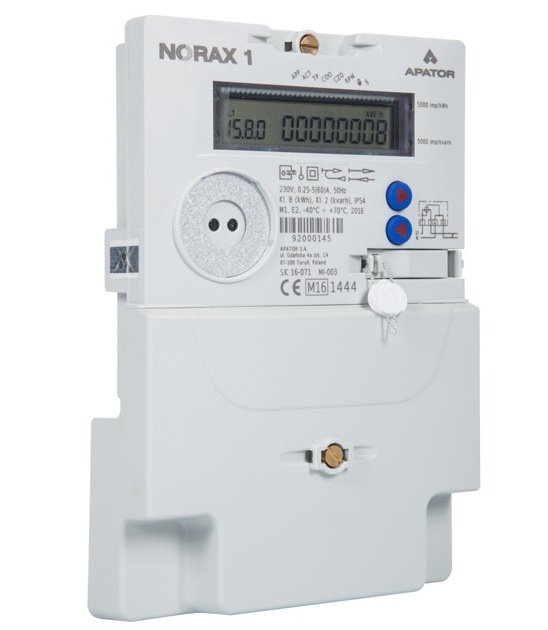
Apator meters, such as the Invonic 2 heat meter, the Ultrimis water meter, or older models like Elf, are characterized by high precision, but they require attention when configuring communication.
- Primary and secondary addressing: ADFweb industrial converters allow polling meters by primary address (Primary Address, 1-250) or secondary address (Secondary Address, based on the serial number). It is recommended to use secondary addressing, which eliminates the problem of duplicated addresses when replacing meters on site.
- VIF/VIFE structure: Data from Apator is encoded according to EN 13757. ADFweb converters include a built-in analyzer of these structures, which makes it possible to automatically extract e.g. energy in $GJ$ or $kWh$ without manual unit conversions.
How to connect and configure an ADFweb converter for an Apator meter?
The success of the integration really depends on correct configuration in the free software provided by the manufacturer, e.g. The success of the integration depends on proper configuration in the SW67671 or SW67056 software (depending on which specific converter model we use, there is dedicated software for it that can be downloaded from our website). It is enough to go through 4 simple steps to make it work:
Step 1: Definition of physical parameters
We set the transmission speed (Baud rate). For Apator meters, the standard is 2400 bps, less often 9600 bps. Incorrect speed is the most common cause of no communication.
Step 2: Line scanning
Thanks to the Scan function, the ADFweb gateway can independently detect all connected meters on the line. This is a critical moment—if the gateway does not “see” the meter, the polarity should be checked (although M-Bus is theoretically resistant to it) and the voltage on the line.
Step 3: Data mapping (M-Bus to BACnet)
This is the center of configuration. In the software, we indicate which field from the M-Bus frame should correspond to a given BACnet object.
Example:
- Field: Energy (Wh) -> BACnet Object: Analog Input 1
- Field: Volume (l) -> BACnet Object: Analog Input 2
- Field: Flow Temp (°C) -> BACnet Object: Analog Input 3
Step 4: BACnet network configuration
We set parameters such as Device ID (a unique number across the entire BACnet network) and the UDP port (standard 47808).
How to solve the issue of polling battery-powered Apator meters using Adfweb converters?
The vast majority of Apator water and heat meters operate in battery mode, which means that each communication session directly affects energy consumption and a shorter battery life. A common mistake in BMS projects is that the supervisory system (in this case BACnet) polls the meters at a very high frequency—every few seconds, or even every second. For battery-powered devices, such an approach can drastically shorten battery life, leading to premature discharge, service interventions, and real operating costs.
To avoid this problem, a good and proven practice is to apply the appropriate ADFweb gateway configuration from the start. The converter should be set so that it physically polls Apator meters at reasonable intervals—typically it is recommended to do this every 15 or 30 minutes. In practice, the readout interval must be adjusted to the project requirements and the characteristics of the installation. However, setting the readout frequency to the suggested 15 minutes helps keep measurement data up to date while minimizing the energy load on the meters.
A key role in this scenario is played by the cache mechanism in ADFweb converters. After reading data from the meters, the converter stores current values in its memory and makes them available to the BMS system regardless of the frequency of actual communication with the metering devices. Thanks to this, the BACnet system can read values even every second, but without direct contact with battery-powered meters.
This approach provides several important benefits at the same time:
- a significant extension of Apator meters’ battery life,
- stable and predictable operation of the entire system,
- no risk of bombarding meters with BMS queries,
- full compatibility with building automation system requirements.
In practice, this means that the ADFweb gateway acts as a buffer and an intelligent intermediary, separating the world of frequent BMS reads from the physical limitations of metering devices. This solution is especially recommended in installations with a large number of meters and in projects where low maintenance cost and long-term system reliability are priorities.
How to deal with voltage drops on the line? Managing long distances
The M-Bus line was designed as a system resistant to electromagnetic interference; however, in large-scale installations—covering hundreds of meters of cabling, multiple floors, and distributed metering points—a natural challenge becomes voltage drops on the line. This problem is particularly intensified in multi-family buildings, public facilities, and industrial installations, where energy, heat, or water meters are located at considerable distances from the concentrator.
M-Bus converters from ADFweb are designed with such scenarios in mind. These devices actively generate and stabilize voltage on the line, ensuring an appropriate power level even with long cable runs and a larger number of connected slaves. This makes reliable communication with Apator meters possible also in installations covering many risers, floor cabinets, and extensive floors, without the risk of unstable readings or periodic transmission dropouts.
Stable electrical parameters of the line translate directly into the quality and continuity of metering data, eliminating issues typical of undersized M-Bus masters, such as random lack of responses, frame errors, or the need to shorten the line. In practice, this means the ability to design long and distributed M-Bus installations without additional signal amplifiers, which simplifies the system architecture and reduces deployment and service costs.
Benefits of using the ADFweb solution for integrators
Using dedicated solutions instead of universal PLC controllers with a “written” driver has key advantages:
- Deployment speed: Thanks to ready-made templates and the scanning function, commissioning time is reduced by approx. 60%.
- Diagnostics: ADFweb software provides a traffic monitor (M-Bus Viewer) that shows data frames in real time. This is invaluable when troubleshooting damaged wiring.
- Certification: Devices have CE certificates and meet electromagnetic compatibility standards, which is a requirement in public projects.
Integrating Apator meters with a BACnet line using ADFweb converters is currently one of the most stable methods of building energy monitoring systems. It allows full data transparency, which in the era of ESG and rising building operating costs is crucial for facility managers.
Thanks to a unique combination of Polish measurement precision and Italian engineering in communication, these systems operate reliably for years, ensuring a fast return on investment through the optimization of utility consumption.
Need help choosing the right converter for your installation? Write or call us—our technical advisors will help you select the right device for your project.