





































BACnet vs Modbus in HVAC control – which protocol to choose for your investment?

In a changing world, with growing environmental awareness and rising energy prices, air conditioning and ventilation systems (HVAC) are no longer separate technological islands. Today, it is standard that the air conditioning system must communicate with the building management system (BMS). Choosing the right communication protocol, BACnet or Modbus, is one of the most important decisions that a designer or integrator must make at the conceptual stage.
The choice of communication in HVAC systems affects not only the cost of devices, but above all the commissioning time of the system and the ease of its later operation.
Modbus - Reliable veteran and simple solutions
Modbus (usually in RTU or TCP version) is a protocol that, despite the passage of time, has not lost its popularity. Its main feature is rawness and simplicity. Data is transmitted in the form of registers- numbers, which makes it extremely lightweight for device processors.
Why choose Modbus in HVAC?
Low implementation cost: Devices with a Modbus interface are usually cheaper than their BACnet counterparts.
Popularity: Most energy meters, air quality sensors and simple air conditioning controllers communicate via Modbus by default.
Clarity in small networks: If you are integrating several air conditioning units in a small office, Modbus will be a fast and economical solution.
The challenge when using devices communicating via Modbus may be that Modbus does not have a standardized data structure. Each device manufacturer provides its own register map. The integrator must manually assign that, for example, register 40001 is the temperature and 40002 is the operating status.
BACnet - Intelligence created for buildings
Unlike Modbus, BACnet was designed from the ground up by the ASHRAE association as a standard dedicated exclusively to building automation. It is an object-oriented protocol, which changes the rules of the game in large installations.
The advantage of BACnet in modern BMS systems:
Interoperability: Devices from different brands understand each other and communicate with one another without complicated mapping.
Self-discovery: The BMS system can automatically scan the network and identify available points (e.g. “Living Room Temperature”), which significantly shortens configuration time.
Rich information: BACnet does not transmit only a raw value. Together with the temperature, metadata is transmitted: unit (°C), status (whether the data is reliable) and control priorities.
When choosing devices communicating via BACnet, you must take into account a higher unit cost of devices and greater requirements regarding the technical knowledge of the installer (especially when configuring a BACnet/IP network).
Direct comparison of BACnet vs Modbus
| Feature | Modbus (RTU/TCP) | BACnet (MS/TP or IP) |
|---|---|---|
| Data structure | Registers (manufacturer map required) | Objects (self-describing data) |
| Configuration | Manual point mapping | Device self-discovery |
| Diagnostics | Basic | Advanced (statuses, alarms) |
| Hardware cost | Low | Medium / High |
| Type of investment | Small facilities, OEM systems | Class A office buildings, hotels, hospitals |
The role of Intesis (HMS) gateways – a bridge between worlds
In engineering practice, we often encounter a hybrid situation. For example, air conditioning units (VRF/VRV) communicate internally using the manufacturer’s standard or Modbus, while the supervisory system throughout the building is based on BACnet.
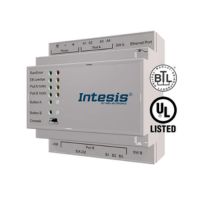
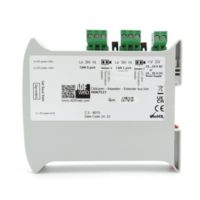
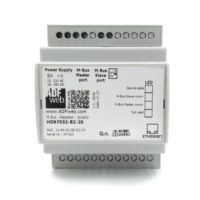
This is where Intesis HMS communication modules, available in the Consteel Electronics offer, play a key role. These gateways act as intelligent translators:
Dedicated solutions: Intesis gateways are optimized for specific brands (Daikin, Mitsubishi Electric, LG, Samsung, Panasonic).
Configuration via Intesis MAPS: This software allows configuration files to be prepared instantly, eliminating the risk of addressing errors.
Bidirectionality: They allow not only parameter reading, but full control – from set temperature, through operating modes, to limiting power consumption (peak shaving).
Summary: What to choose?
The choice of protocol depends on the scale and purpose of the facility:
Choose Modbus if you are working on a smaller investment, have a fixed budget, and the BMS system is simple or based on PLC controllers.
Choose BACnet if you are designing a modern commercial building where the ease of integrating multiple systems (HVAC, lighting, access) and advanced data analytics are critical.
Regardless of the selected protocol, the key to success is reliable communication hardware. Intesis gateways make the differences between protocols stop being a barrier and become a technical choice adapted to the needs of your client.