













































Reading HART Meters via a Modbus Supervisory Device

Reading HART meters via a Modbus supervisory device means making data from intelligent HART transmitters available as standard Modbus registers.
Reading HART meters via Modbus is one of the most common methods used to integrate older and newer measurement devices with industrial automation systems. In practice, this means that a PLC, SCADA system, HMI panel, data logger or industrial computer does not need to support the HART protocol directly. Instead, it communicates with a gateway or converter which polls HART meters on the field side and provides the collected data to the supervisory system as Modbus RTU or Modbus TCP.
This solution is especially useful in plants where pressure, temperature, flow, level, density or other measurement transmitters equipped with HART communication are used. The HART protocol allows not only the basic process value to be retrieved, but also diagnostic data, status information, device identification, measurement units and additional process variables. By using a HART to Modbus gateway, this information can be easily used in a PLC or SCADA system without the need to extend the controller with native HART modules.
What is HART communication?
HART, or Highway Addressable Remote Transducer, is a communication protocol used mainly in measurement and control instrumentation. One of its key features is the ability to transmit digital information while maintaining the classic 4–20 mA analog signal. In a typical installation, this means that the main process value can still be transmitted as an analog signal to the control system, while additional digital information is sent over the same measurement loop.
In practice, a HART meter can provide much more data than the loop current alone. In addition to the primary process value, such as pressure, level, temperature or flow, it is possible to read the device status, measuring ranges, units, TAG number, manufacturer information, additional variables and diagnostic messages. These data are highly valuable for maintenance teams, process diagnostics and remote monitoring of industrial installations.
What is the role of the Modbus supervisory device?
In a Modbus-based system, the supervisory device, traditionally referred to as the Modbus Master, initiates requests to subordinate devices. In newer terminology, the terms Modbus Client and Modbus Server are increasingly used, although in industrial environments the terms Master and Slave are still commonly found in technical documentation, controller configuration and device descriptions.
The Modbus supervisory device can be a PLC, SCADA system, HMI operator panel, industrial computer, data concentrator or another data acquisition system. Its task is to cyclically send requests to the HART Modbus gateway and read specific register addresses. From the PLC perspective, it does not matter that the original data source is a HART transmitter. For the control program, these are standard data stored in Modbus registers.
This is very important from an integration point of view. The PLC does not need to know HART commands, the structure of HART frames or the communication details of the field device. The entire HART protocol handling is performed by the gateway. The supervisory system uses a simple and well-known register reading mechanism, such as Holding Registers or Input Registers.
How does a HART Modbus gateway work?
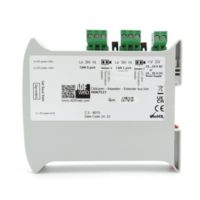
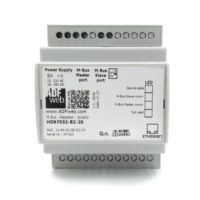
A HART Modbus gateway acts as an intermediary between HART measurement devices and the Modbus supervisory system. On the HART side, the gateway acts as a polling device. It sends requests to transmitters, receives responses, interprets the data and stores them in its internal memory. On the Modbus side, it operates as a subordinate device or server which makes the data available in the form of registers.
In simplified terms, the whole process can be described in several steps. First, the gateway communicates with the HART meter and retrieves selected parameters. Then it converts the data into a format understandable for Modbus. The next step is to store the values in specific registers. Finally, the PLC, SCADA system or HMI reads these registers as typical Modbus RTU or Modbus TCP data.
Depending on the device model, the gateway may support one or multiple HART channels, a different number of devices in multidrop mode and various data types. Some gateways provide a ready-made register map, while others allow the user to configure which HART parameters should be assigned to specific Modbus addresses. In industrial applications, the ability to set the polling frequency, timeouts, HART addresses, operating mode and data format is also very important.
Mapping HART data to Modbus registers
The Modbus register map is the key element of the integration. It defines the Modbus address under which a specific value retrieved from the HART device is available. For example, the main process value, or Primary Variable, may be made available as a 32-bit floating-point number in two consecutive Holding Registers. The 4–20 mA loop current may be placed in the next pair of registers, while the device status can be assigned to a separate diagnostic register.
| Data from the HART device | Example Modbus mapping | Meaning in the system |
|---|---|---|
| Primary Variable | Holding Register 40001–40002 | Main measurement value, e.g. pressure or level |
| Loop Current | Holding Register 40003–40004 | Actual 4–20 mA loop current |
| Device Status | Holding Register 40005 | Information about device condition and possible faults |
| TAG or identification | Text registers or data blocks | Identification of the measurement point in the system |
During configuration, attention must be paid to the data type, byte and word order, scaling and value interpretation. Many process values are transmitted as 32-bit floating-point numbers, which means that one parameter may occupy two Modbus registers. If the PLC and the gateway interpret word order differently, the read value may be incorrect even if communication itself is working properly. For this reason, endianess settings, FLOAT format, ranges and units should always be verified during commissioning.
Point-to-point and multidrop in HART installations
In HART installations, two basic operating scenarios are commonly found. The first is point-to-point mode, where one HART device is connected to one loop. The 4–20 mA analog signal can still be used as the main measurement signal, while digital communication allows additional diagnostic and configuration data to be retrieved. This is a common approach in modernized installations where the basic analog infrastructure remains unchanged.
The second option is multidrop mode, in which multiple HART devices operate on one communication bus and each device has its own address. In this configuration, the gateway polls individual devices according to the configured sequence. Multidrop mode reduces the amount of cabling and allows data to be collected from many measurement points, but it requires correct device addressing and consideration of update time. The more devices there are in a given segment, the longer the full polling cycle may take.
Diagnostics and HART device status information
One of the greatest advantages of reading HART data via Modbus is the ability to transfer field device diagnostics to the supervisory system. In a classic approach, the 4–20 mA signal mainly provides the measurement value. HART communication makes it possible to obtain additional information which may indicate a problem with the sensor, measuring range, electronics, power supply, calibration or the process itself.
Once properly mapped, HART status information can be used in PLC or SCADA systems to generate alarms, service warnings, diagnostic messages and maintenance reports. As a result, the operator can see not only the measurement value itself, but also whether the device is operating correctly. This is particularly important in installations where an incorrect measurement may lead to improper process control, downtime, technological losses or incorrect operator decisions.
Typical industrial applications
HART to Modbus converters are used wherever existing HART meters need to be integrated into an automation system based on Modbus. Typical applications include process plants, water and wastewater installations, district heating, power generation, chemical industry, pharmaceutical industry, food industry, fuel storage facilities, water treatment plants and environmental monitoring systems.
In practice, a HART Modbus gateway can be used to read pressure transmitters on pipelines, level measurements in tanks, temperature control in technological installations, medium flow monitoring, data acquisition from measurement devices in distributed facilities and transmission of diagnostic information to SCADA systems. If the supervisory system supports Modbus TCP, data can be transmitted via Ethernet. If the infrastructure is based on serial communication, Modbus RTU over RS-485 is often used.
What should be considered when selecting a HART Modbus gateway?
When selecting a gateway, the first aspects to verify are the number of supported HART channels, the maximum number of devices, the supported operating mode, the available Modbus interface, the configuration method and the data mapping capabilities. Environmental parameters, mounting method, power supply, galvanic isolation, EMC immunity and the availability of technical documentation with a clear register map are also important.
In industrial applications, it is not worth limiting the integration only to the process value itself. Much greater value is achieved by integrating diagnostic data, status information and identification data. This makes it possible to use the full potential of intelligent HART transmitters and increase the transparency of the entire measurement system.
Summary
Reading HART meters via a Modbus supervisory device is based on using a communication gateway which retrieves data from HART transmitters and makes them available as Modbus registers. This allows a PLC, SCADA system or HMI panel to use HART data without native support for the HART protocol. The integration is transparent for the supervisory system because all values are available in the standard Modbus RTU or Modbus TCP format.
The most important elements of a successful implementation are proper gateway configuration, correct HART device addressing, register mapping, data types and polling frequency. A well-designed system allows not only measurement values to be read, but also diagnostics, status information and service data to be used. As a result, a HART Modbus gateway becomes a practical tool for modernizing installations, integrating measurement instrumentation and increasing data availability in industrial automation systems.