




































How to Avoid Industrial Network Instability? A Practical Guide for Automation Engineers Using the IES2100SL Switch Series
In industrial automation, one of the most common problems is unstable Ethernet communication
In industrial automation, one of the most frequently encountered issues is unstable Ethernet communication, manifested as sporadic connection drops, disappearing SCADA devices, Modbus TCP frame errors, or frozen HMI panels. For an automation engineer, this means unplanned downtime, stressful diagnostics, and the need for immediate intervention in a system that should operate 24/7 without human involvement.
The problem intensifies especially where cheap office-grade switches are used—devices not designed to operate in harsh industrial conditions such as high or low temperatures, EMC interference, unstable power, or continuous vibration. As a result, even a sophisticated control system equipped with high-end PLCs and HMI panels can behave unpredictably, and the culprit often turns out to be the cheapest component in the cabinet: the switch.
This is exactly where an industrial switch in a metal housing, designed for continuous operation and resistance to environmental conditions, becomes essential. One of the series that gained strong popularity among installers and maintenance teams is the IES2100SL family—economical yet fully industrial Ethernet switches.
Where do the problems really come from? The main cause of instability is not protocols — it's the physical layer
In automation, Modbus does not “go bad,” EtherNet/IP does not “misbehave,” and Profinet does not “freeze” on its own. In the vast majority of cases, the real cause of instability is something far more fundamental — the physical layer of the network, which is exposed to stresses that office IT equipment never encounters. Problems begin where the comfort of an air-conditioned office ends, and real production begins: high temperature, strong electrical noise, motors starting hundreds of times a day, vibration, and voltage dips.
This is why communication failures in production halls, packaging lines, HVAC systems, water treatment plants, or energy facilities usually do not originate from PLC configuration but from three chronically neglected areas:
1. EMC interference from inverters, motors and contactors
Inverters generate powerful electrical noise. Contactors induce voltage spikes during every switching event. High-power motors can “wipe out” the signal on an RJ45 cable so effectively that a frame passes only occasionally.
In such conditions, office switches are completely defenseless because they lack:
- shielding,
- port isolation,
- over-voltage protection,
- ESD and EFT immunity,
- high-frequency signal filtering.
The result? In strong electromagnetic fields, they can:
- freeze,
- reset during every large motor start,
- lose individual ports,
- generate random frame errors that look like “PLC faults.”
This is why an office switch works reliably only when it has nothing difficult to do — which in industrial environments means almost never.
2. Temperatures beyond the operating range
A typical office environment sits comfortably at around 22°C with air conditioning in summer. Meanwhile, real industrial conditions involve 40°C to 60°C inside control cabinets, even with the doors open.
An office switch rated 0–40°C has no realistic chance of operating reliably in such temperatures. In industrial cabinets, the ambient temperature often exceeds its maximum operating limit.
In reality, industrial switches must handle:
- 55–60°C inside machine cabinets,
- 45°C in warehouses during summer,
- –20°C in outdoor technical enclosures,
- rapid temperature fluctuations,
- continuous operation at full port load.
Office-grade electronics exposed to such extremes begin to:
- degrade electrolytic capacitors,
- lose CPU stability,
- freeze after several hours,
- reset when overheated.
This is why issues that “only appear in the afternoon” often have a single root cause — temperature, not protocol settings.
3. Lack of redundant power supply
This is the most frequently ignored factor. A single:
- voltage fluctuation,
- brief drop on the power line,
- accidental unplug during maintenance,
- phase loss,
- UPS restart,
and suddenly the entire network segment disappears from SCADA — even though all devices are logically operational.
Office switches typically have a single power input and no protection. Industrial switches, however, provide:
- dual redundant power inputs,
- reverse polarity protection,
- short-circuit protection,
- voltage surge immunity during heavy equipment startup.
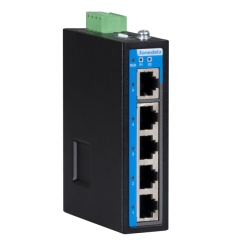
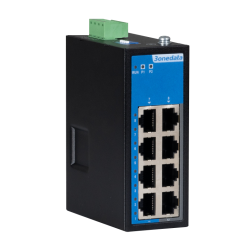
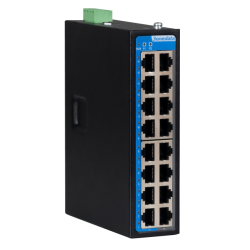
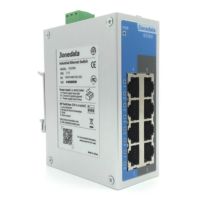
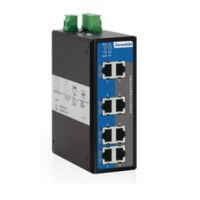
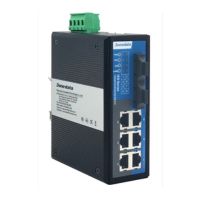
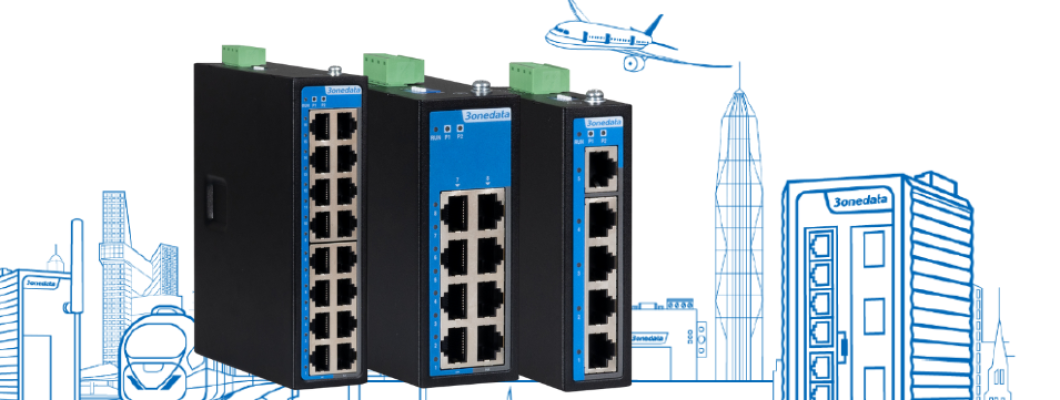
These three areas—EMC resistance, industrial-grade temperature range, and redundant power supply—are exactly what the IES2100SL switch series addresses. These switches are available in 5-, 8- and 16-port variants and come with a standard 6-year manufacturer warranty.
Why does the IES2100SL switch solve these problems?
The IES2100SL switch series was designed as a bridge between simple installations and environments requiring high resilience. Its effectiveness comes from several key features:
Metal housing (IP40) — real protection against overheating, dust and EMC interference
A metal housing not only protects the electronics but significantly improves resistance to interference and vibration. In dusty, oily or high-temperature environments, a metal enclosure is essential. In facilities with robots, presses, packaging machines or injection molding units, this is a fundamental requirement.
Operating temperature from –40°C to +75°C
Such a wide temperature range eliminates most stability issues in control cabinets, outdoor enclosures, substations, and CCTV systems. The switch is designed for extreme conditions, ensuring stable performance without overheating.
Redundant 9–60 VDC power supply
If one power source fails, the switch stays online — PLCs continue communicating with SCADA and HMI systems. Redundant supply eliminates a single point of failure. If one source fails due to vibration, voltage loss, overload, or power supply failure, the device instantly switches to the second input and keeps operating without interruption.
DIP-switch functions as “mini management”
Although the IES2100SL is an unmanaged switch, it offers features typically found only in Layer 2 devices, such as VLAN isolation, loop detection, storm suppression and flow control. These functions eliminate typical issues in multi-branch industrial installations.
DIN-rail mounting
Quick installation, no additional accessories needed, and installed exactly where an industrial switch should be — inside a control cabinet next to the PLC and I/O modules.
| Specification | IES2100SL-5T-2LV 5×RJ45
View product | IES2100SL-8T-2LV 8×RJ45
View product | IES2100SL-16T-2LV 16×RJ45
View product |
|---|---|---|---|
| Device Type | Industrial unmanaged 10/100 Ethernet switch | Industrial unmanaged 10/100 Ethernet switch | Industrial unmanaged 10/100 Ethernet switch |
| Ethernet Ports | 5 × 10/100Base-T(X) RJ45 | 8 × 10/100Base-T(X) RJ45 | 16 × 10/100Base-T(X) RJ45 |
| DIP Switch Functions | Storm suppression, flow control, loop detection, VLAN | Storm suppression, flow control, loop detection, VLAN | Storm suppression, flow control |
| Power Supply (Redundant) | Dual DC power input | Dual DC power input | Dual DC power input |
| Input Voltage Range | 12/24/48 VDC (9–60 VDC) | 12/24/48 VDC (9–60 VDC) | 12/24/48 VDC (9–60 VDC) |
| Power Consumption (Idle) | approx. 0.2 W @12 VDC | approx. 0.4 W @12 VDC | approx. 0.7 W @48 VDC |
| Power Consumption (Full Load) | approx. 0.8 W @12 VDC | approx. 3.0 W @12 VDC | approx. 2.9 W @48 VDC |
| MAC Address Table | 2K entries | 2K entries | 8K entries |
| Backplane Bandwidth | approx. 1 Gbit/s | approx. 1.6 Gbit/s | approx. 3.2 Gbit/s |
| Operating Temperature | −40°C … +75°C | −40°C … +75°C | −40°C … +75°C |
| Protection Rating | IP40 | IP40 | IP40 |
| Mounting | DIN rail | DIN rail | DIN rail |
| Standards | IEEE 802.3 / 802.3u / 802.3x / 802.1Q | IEEE 802.3 / 802.3u / 802.3x / 802.1Q | IEEE 802.3 / 802.3u / 802.3x / 802.1Q |
| Dimensions (W×H×D) | 28 × 103 × 78 mm | 40.6 × 103 × 78 mm | 40.6 × 150 × 120 mm |
| Warranty | 5 years | 5 years | 5 years |
Real-world scenario: when does IES2100SL save an installation?
Imagine a typical automation setup with a PLC, several HMI panels, a SCADA system, inverters, field sensors, and a few CCTV cameras. Everything works fine until the system is expanded — additional modules are added, some devices are moved closer to machines, and port usage increases. Suddenly, problems appear: intermittent communication drops, Modbus TCP errors, cameras freezing, HMI panels disappearing, or SCADA alarms like “device unreachable.” In over 80% of these cases, the root cause is the switch, which cannot withstand the environment.
Replacing the standard switch with IES2100SL-5T-2LV, IES2100SL-8T-2LV or IES2100SL-16T-2LV (depending on port requirements) eliminates the issue almost immediately. This is why the IES2100SL series is so often chosen by maintenance engineers who need a “install and forget” solution. The 6-year warranty further confirms its durability and reliability.
Why are searches like “why does Ethernet drop?” or “industrial switch keeps resetting” so common?
Ethernet drops and spontaneous switch resets are everyday challenges for automation engineers. They face issues such as: PLC–HMI communication failures every few hours, cameras disappearing when a press starts, switches rebooting during inverter startup, or SCADA communication failing in low temperatures. The solution in most cases is not an expensive managed switch, but a rugged industrial switch that handles temperature, noise, stable power, and network loops — exactly what the IES2100SL-5T-2LV, IES2100SL-8T-2LV and IES2100SL-16T-2LV provide. At an extremely competitive price — the 5-port model costs only 199 PLN net, and the 16-port version stays under 770 PLN net.
The IES2100SL industrial switch — the easiest way to get a stable industrial network
If you struggle with Ethernet instability, random communication errors, switch resets, EMC-related problems, or extreme temperature conditions, installing an IES2100SL switch is one of the most effective and economical ways to eliminate these issues.
The IES2100SL industrial switch operates reliably for years, requires no configuration, and withstands everything that typically destroys office-grade switches. The manufacturer — 3onedata — provides a 6-year warranty, and by choosing this solution you also receive free technical support in English. Maybe it’s time to eliminate your installation problems once and for all and enjoy a stable system without downtime and unnecessary losses?