




























Modbus RTU or Modbus TCP in an electric car charger?

The choice between Modbus RTU and Modbus TCP in an electric vehicle charger installation should not be treated as a simple choice of one protocol instead of the other. In practice, EV charging infrastructure is increasingly part of a larger automation system: it works with energy meters, network analyzers, PLC controllers, EMS systems, DLM systems, facility switchboards and supervisory systems. Therefore, the proper selection of communication depends not only on the charger itself, but on the entire architecture of the building or facility.
Modbus RTU is very commonly found in energy meters, power quality analyzers, I/O modules and devices operating on an RS-485 bus. Modbus TCP is better suited to installations where communication takes place over Ethernet and data must be transferred to a PLC, SCADA, BMS, EMS or charging management system. In many projects, the best solution is not to choose “RTU or TCP”, but to combine both layers using a properly selected Modbus gateway, serial device server or RS-485/Ethernet converter.
The role of Modbus in an electric vehicle charger.
In electric vehicle charging installations, Modbus communication is mainly used for local data exchange. OCPP is usually responsible for communication between the charger and the operator, billing or charging service management platform. Modbus, on the other hand, is very practical in the technical layer: for reading meters, analyzing load, integrating with PLCs, transferring information to EMS and implementing dynamic load management.
For example, an energy meter can measure the total power consumption of a building, and the charger or DLM system can limit the charging current based on this data. If a photovoltaic installation, energy storage system, heat pump or production line operates in the facility, the energy management system must know how much power actually remains available for EV chargers. This is exactly where Modbus communication makes it possible to connect measuring devices, actuators and supervisory systems into one logical setup.
In small installations, communication can be very simple: an energy meter with RS-485 sends data to the charger or controller. In larger facilities, more elements appear: several meters, several switchboards, a PLC controller, EMS, BMS system and many charging points. This is when the choice between Modbus RTU and Modbus TCP starts to have a major impact on stability, scalability and ease of servicing.
When should you choose Modbus RTU?
Modbus RTU is the natural choice when the installation is based on an RS-485 bus. It is a very popular standard in energy meters, power quality analyzers, transducers, inverters, I/O modules and building automation devices. In EV chargers, Modbus RTU most often appears where the key data comes from an energy meter installed in a switchboard.
This scenario is typical for simple DLM systems. The meter measures the energy consumption of the entire facility, and the charging control system reads current power, current or energy values. If the facility approaches the contracted power limit, the charger reduces the charging power. When the load decreases, the power can be increased again. This allows the user to charge the vehicle without the risk of overloading the installation.
The advantage of Modbus RTU is its simplicity and low implementation cost. A single RS-485 bus can support many devices, and basic communication does not require extensive Ethernet infrastructure. This is especially beneficial in electrical cabinets, where the meter, network analyzer and communication gateway are located close to one another.
However, it is important to remember the limitations. Modbus RTU requires the bus to be installed correctly: proper cable routing, termination, device addressing, transmission speed, parity and stop bit settings. In larger installations, where chargers and switchboards are located far apart, one long RS-485 bus may be more difficult to diagnose than several shorter segments connected via Ethernet.
When should you choose Modbus TCP?
Modbus TCP operates over an Ethernet network, which makes it better suited to distributed installations, supervisory systems and infrastructure that should be easy to expand. If the EV charger is to communicate with a PLC, EMS, BMS, SCADA or local industrial network, Modbus TCP will usually be a more convenient choice than running an RS-485 bus directly across the entire facility.
Modbus TCP works particularly well in company car parks, industrial plants, hotels, office buildings, logistics centers and fleet facilities. In such locations, there may be several or several dozen chargers, and data must be sent to one management system. Ethernet makes addressing, network segmentation, integration with industrial switches and connection to supervisory systems easier.
Modbus TCP is also convenient from the PLC and EMS point of view. The controller can read data from many devices over an IP network, and the energy management system can collect measurements from different parts of the facility. However, this does not mean that all devices must have an Ethernet port. Very often, energy meters and power quality analyzers still operate over RS-485. In this case, a Modbus TCP to Modbus RTU gateway is needed to connect the world of the serial bus with the world of Ethernet.
Selecting the protocol for meters, PLC, EMS and DLM.
The best starting point when designing communication for an EV charger is to check which devices are supposed to deliver data to the system. If the most important element is an energy meter with an RS-485 port, Modbus RTU can remain the local measurement layer. However, if data from this meter must be visible in a PLC or EMS over Ethernet, a Modbus gateway should be used.
In a PLC-based system, it is necessary to determine which device has the supervisory role. In many installations, the PLC controller or EMS system acts as a Modbus TCP Master or Client and reads registers from measuring devices. Energy meters operate as Modbus RTU Slave devices, and the communication gateway makes them available in the Ethernet network. Such an architecture is clear, easy to scale and well suited to installations where the EV charging system must cooperate with building automation.
In the case of DLM, the most important factor is stable and predictable reading. The dynamic load management system must know the current load of the facility and regulate charging power on this basis. If the reading from the meter is unstable, delayed or incorrectly mapped, the charger may react too slowly. That is why in DLM projects it is worth avoiding random selection of communication devices. The Modbus gateway should be selected according to the number of RTU devices, number of queries, required galvanic isolation, available power supply, network topology and operating conditions inside the switchboard.
Modbus gateways, serial device servers and RS-485/Ethernet converters.
In EV charging installations, the charger and meter alone are very often not enough. An intermediary device is needed to enable data exchange between RS-485 and Ethernet. This is what Modbus gateways, RS-485/Ethernet converters and serial device servers are used for. Each of these solutions has a slightly different application.
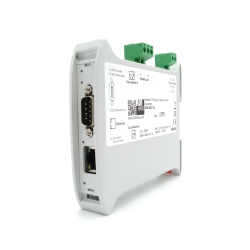
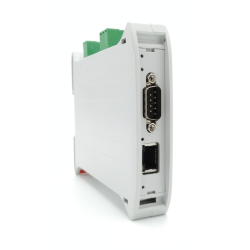
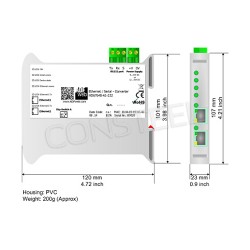
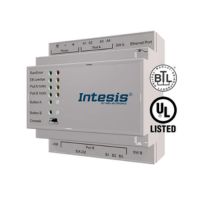
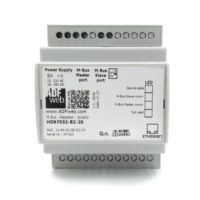
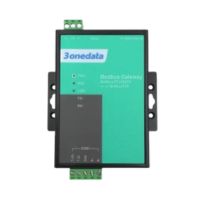
A Modbus gateway is the right choice when the supervisory system using Modbus TCP is supposed to communicate with Modbus RTU devices. An example is HD67507-A1, an industrial Modbus TCP to Modbus RTU converter that can operate as an intermediary element between the Ethernet network and devices on RS-485. In more demanding installations, it is worth considering HD67508-A1-485, a converter with two Ethernet ports, one RS-485 port, DIN rail mounting and an industrial operating range.
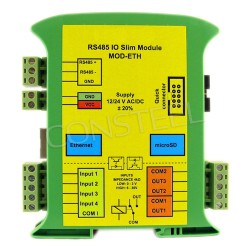
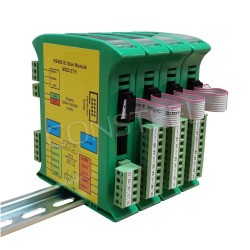
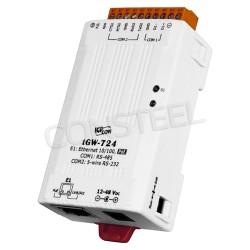
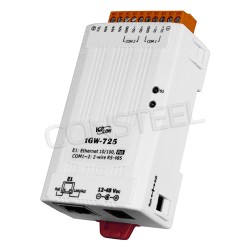
In simpler applications, a good solution may be MOD-ETH, a Modbus TCP to Modbus RTU/ASCII gateway with Ethernet and RS-485 interfaces. This type of device is useful when a PLC controller, industrial computer or EMS system must read data from serial devices. In installations where PoE power supply or compact gateways for operation with Modbus TCP and RTU/ASCII are required, the tGW series can also be considered, for example tGW-724 or tGW-725.
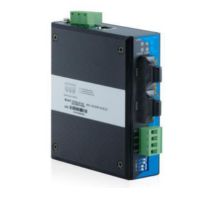
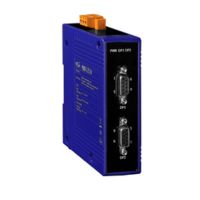
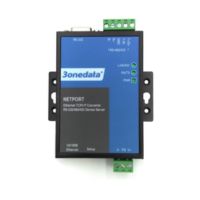
A serial device server has a slightly different task. Its function is to make an RS-232, RS-422 or RS-485 port available over an Ethernet network. This can be useful for remote access to serial devices, diagnostics or integration of devices that do not have their own Ethernet port. The Consteel Electronics offer includes, among others, NP301, NP302, NP314 and NP318 serial device servers. When designing EV infrastructure, however, it is necessary to distinguish whether a full Modbus TCP/RTU protocol gateway is required or whether it is only necessary to make a serial port available in the network.
Comparison table of Modbus RTU and Modbus TCP.
| Criterion | Modbus RTU | Modbus TCP | Conclusion for an EV charger |
|---|---|---|---|
| Communication layer | RS-485, serial communication | Ethernet, IP network | RTU for local meters, TCP for supervisory systems |
| Typical devices | Energy meters, power quality analyzers, I/O modules | PLC, EMS, BMS, SCADA, industrial computers | In practice, mixed communication is often required |
| Scalability | Good for local RS-485 segments | Better for multiple chargers and distributed facilities | With a larger number of charging points, it is worth basing the supervisory layer on Ethernet |
| DLM | Good for reading the meter in the switchboard | Good for transferring data to EMS or PLC | Most often, the meter operates over RTU and supervisory control over TCP |
| Intermediary device | Requires a gateway when integrated with Ethernet | Can read data through a Modbus gateway | It is worth selecting a Modbus TCP/RTU gateway or RS-485/Ethernet converter |
Example communication architectures for EV chargers.
The first variant is a small installation with one charger and one energy meter. If the meter has RS-485 and the charger supports Modbus RTU, communication can be implemented directly. This solution is simple, but less flexible if EMS, PLC or additional charging points are added in the future.
The second variant is an installation with an RS-485 meter and a supervisory system over Ethernet. In this case, it is worth using a Modbus TCP to Modbus RTU gateway. The meter remains in the RS-485 layer, while the PLC or EMS reads data via Modbus TCP. This is a very practical architecture for commercial buildings, small production plants and company car parks.
The third variant is a larger installation with several chargers, several meters and a DLM system. In such a setup, it is better to avoid one long RS-485 bus running across the entire facility. A more reasonable approach is to divide the installation into local measurement segments and bring data into the Ethernet network through Modbus gateways or RS-485/Ethernet converters. The supervisory layer, meaning PLC, EMS or BMS, then communicates via Modbus TCP.
The fourth variant is the modernization of an existing facility. In many buildings, energy meters and power quality analyzers with Modbus RTU are already operating. Adding EV chargers does not have to mean replacing the entire measuring equipment. It is enough to select the appropriate communication gateway that will enable integration of old RS-485 devices with the new charging management system.
The most common mistakes in Modbus integration for EV chargers.
The first mistake is choosing the protocol solely based on the charger datasheet. If the charger supports Modbus TCP, but the energy meter only has RS-485, the system will still require an intermediary device. If, on the other hand, the charger supports Modbus RTU, but the EMS operates over Ethernet, communication will not be complete without a Modbus gateway.
The second mistake is failing to analyze communication roles. In Modbus, it is necessary to know which device initiates queries and which one responds. The energy meter most often operates as a slave or server device, while the PLC, EMS or DLM system acts as a master or client. Incorrectly assuming these roles may result in devices being physically connected but not exchanging data.
The third mistake is running an excessively long and complex RS-485 bus without dividing it into segments. In a small switchboard, RS-485 is a very good solution. In a large facility with many chargers, it is better to shorten serial sections and move to Ethernet earlier. This improves diagnostics, limits the impact of a failure in one segment and makes system expansion easier.
The fourth mistake is confusing a Modbus gateway with a serial device server. A Modbus gateway is intended for protocol conversion between Modbus TCP and Modbus RTU. A serial device server makes a serial port available in an Ethernet network, but it does not always implement the same communication logic as a dedicated Modbus gateway. In DLM and EMS systems, the device must be selected according to the actual method of data exchange.
How to select Modbus communication for EV charging infrastructure?
If the installation is small and the charger is mainly to cooperate with one energy meter in the same switchboard, Modbus RTU may be sufficient. It is a simple, economical solution that automation engineers know well. The condition is correct installation of the RS-485 bus and matching communication parameters between devices.
If the system is to cooperate with a PLC, EMS, BMS, SCADA or a larger number of chargers, it is worth choosing Modbus TCP as the supervisory layer. Ethernet provides greater flexibility, easier expansion and more convenient data collection from many points in the installation. In such a setup, local measuring devices can still operate over Modbus RTU, but their data should be made available through a Modbus TCP/RTU gateway.
The most universal architecture for EV charging infrastructure is therefore as follows: energy meters, power quality analyzers and local measuring devices operate over Modbus RTU on RS-485, while PLC, EMS, DLM and supervisory systems communicate over Modbus TCP. Between these layers, an industrial Modbus gateway or RS-485/Ethernet converter operates, selected according to the number of devices, operating conditions and required reliability.
In the Consteel Electronics offer, suitable devices for such applications include, among others, HD67507-A1 and HD67508-A1-485 converters, the MOD-ETH gateway, tGW series devices and NP301, NP302, NP314 and NP318 serial device servers. This makes it possible to build both simple meter-to-charger communication and a more advanced system in which data from meters is transferred to a PLC, EMS or DLM via an Ethernet network.
The final decision should result from the architecture of the entire installation, not only from the choice of the charger itself. It is worth checking the meter type, cable distances, number of charging points, PLC role, EMS requirements, DLM implementation method and the possibility of later expansion. Only then can you consciously decide whether Modbus RTU is sufficient, whether Modbus TCP will be better, or whether it will be necessary to combine both standards through a Modbus gateway.
Do you need to select a converter for an EV charger?
Check the category of Consteel Electronics industrial protocol converters or contact the technical team to select a Modbus gateway, serial device server or RS-485/Ethernet converter for energy meters, PLC, EMS, DLM and electric vehicle charging infrastructure.