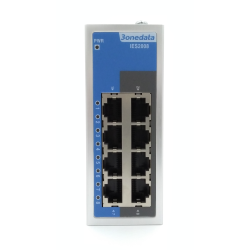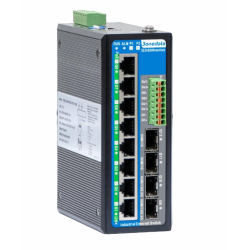
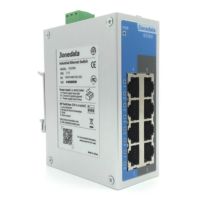
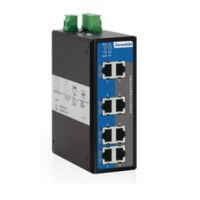
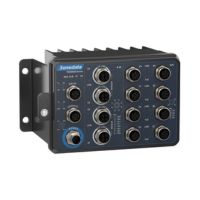
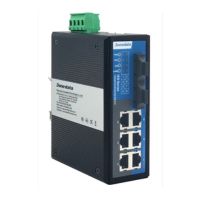
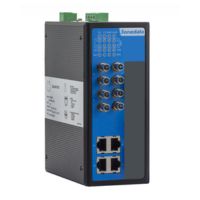

































DIN rail switch - what is it, how does it work and how do I choose one?
1. Introduction – What is a DIN rail switch?
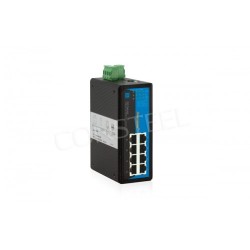
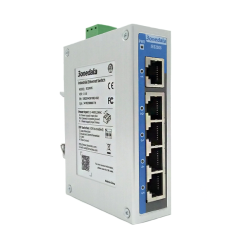
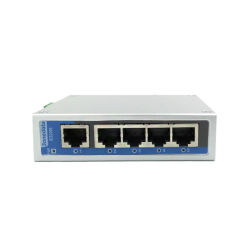
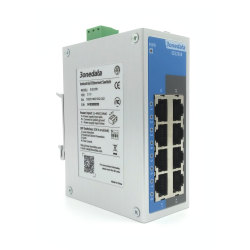
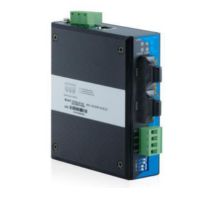
A DIN rail switch is an industrial network switch that enables reliable communication in automation systems, energy sectors, and monitoring applications. The device is mounted on a DIN rail, making installation in control cabinets easy. With its compact size and high resistance to external factors, an industrial switch ensures stable data transmission even in harsh environmental conditions. Depending on the model, it can support Fast Ethernet (100 Mbps) or Gigabit Ethernet (1 Gbps) and offer PoE functionality, allowing connected devices to be powered without additional cables.
2. How does a DIN rail switch work?
A DIN rail switch is a network device that forwards data packets between connected devices, ensuring stable and efficient communication. By utilizing Ethernet technology, the switch enables fast data transmission between PLC controllers, sensors, operator panels, and other industrial devices.
The switch operates based on intelligent network traffic management. It identifies the MAC addresses of connected devices and transmits data packets directly to the appropriate ports, eliminating collisions and increasing network efficiency. Managed versions allow for VLAN configuration, QoS, and redundancy, ensuring security and optimized data transmission.
3. Key features of DIN rail switches
An industrial switch mounted on a DIN rail stands out due to its compact design, resistance to harsh environmental conditions, and advanced networking functions. The device supports network redundancy, ensuring stable and uninterrupted communication even in the event of a connection failure.
Key features include high resistance to temperatures (-40°C to 75°C), electromagnetic interference (EMC), PoE support for powering cameras and sensors, and VLAN, QoS, and IGMP Snooping functions in managed models. The DIN switch is an ideal solution for industrial automation, energy systems, and monitoring applications.
4. How to choose a DIN rail switch?
Choosing the right DIN rail switch depends on the application type, number of ports, and network management requirements. In installations requiring network traffic control, it is worth selecting a managed switch that supports VLAN, QoS, and IGMP Snooping.
For industrial environments, key factors include redundant power supply, a wide temperature range (-40°C to 75°C), and resistance to EMC interference. For IP monitoring systems, consider models with PoE support, enabling power supply to cameras and sensors without additional wiring.
5. Installation and configuration of a DIN rail switch
Proper installation of a DIN rail switch ensures network stability and security for industrial devices. Mounting on a standard 35 mm DIN rail allows for quick and convenient placement in a control cabinet without requiring additional brackets.
After securing the switch, connect the power supply with the appropriate voltage range (typically 12-48 VDC) and Ethernet cables to the available RJ45 or fiber optic SFP ports. For PoE-enabled models, ensure compatibility with the required power standard for end devices.
For managed switches, configuration is performed via the WebGUI, CLI, or SNMP. You can set up VLAN, QoS, and network redundancy (RSTP, ERPS) to optimize industrial network performance. It is also recommended to configure security features such as access control and MAC filtering.
6. Summary
A DIN rail switch is a reliable solution for industrial Ethernet networks, offering compact design, high environmental resistance, and a wide range of network functions. With easy mounting and flexible configuration, it is ideal for industrial automation, transportation systems, and monitoring applications.
If you're looking for a high-quality DIN rail switch, check out our industrial switches. If you have any questions, feel free to contact our team – we will help you choose the best device for your needs!