


































5G router in external CCTV monitoring – does it make sense and how to ensure a stable connection?

In theory, the concept looks simple: camera, power supply, data transmission, and remote viewing. In practice, it is the connectivity and the industrial routers used that most often determine whether a CCTV monitoring system operates predictably or only “works on paper”. This is especially true for outdoor sites such as parking lots, construction sites, open warehouses, photovoltaic farms, temporary facilities, security points, road infrastructure, and distributed locations where bringing in fiber optics is unprofitable, time-consuming, or simply impossible.
In such deployments, one question comes up more and more often: does a 5G router make sense? And right after that, a second one: is it worth buying a 5G router for outdoor monitoring instead of classic LTE or a wired solution? In many cases, the answer is yes, but only if the device is selected as part of an industrial infrastructure, not as just another “mobile internet box”. In CCTV systems, it is not only high bandwidth that matters, but above all uplink stability, resistance to interference, proper VPN operation, environmental durability, and the ability to maintain continuous communication for long periods without manual intervention.
Does a 5G router make sense for CCTV monitoring?
Yes, but not simply because 5G is “more modern”. The value of this technology comes from the real needs of monitoring systems. IP cameras generate constant traffic, recorders require predictable remote access, and the operator or service team wants to log into the system quickly without spending hours fighting with poor connection quality. If a site does not have good wired infrastructure, and the monitoring system must be launched quickly and operate independently of local telecom limitations, then 5G industrial routers become a real engineering tool rather than just a fashionable addition to a specification sheet.
In practice, a 5G industrial router makes the most sense in four types of deployments:
- in locations where there is no fiber optic connection and there will not be one for a long time,
- in temporary installations where the investor does not want to bear the cost of bringing in a wired connection for only a few months,
- in distributed facilities where monitoring has to work across multiple points and each site needs independent connectivity,
- and wherever fast deployment and the option to relocate the system later without rebuilding the entire infrastructure are important.
That is why the question does a 5G router make sense? is best replaced with another one: in which scenario is it more cost-effective, stable, and practical than a wired solution or classic LTE? In outdoor monitoring, the answer very often favors 5G, especially if the site is expected to grow, change, or require flexible remote access.
Why is connection stability more important than raw speed?
When choosing data transmission equipment, many people still focus almost exclusively on maximum download values. For CCTV, that is the wrong starting point. Monitoring needs not record-breaking download speed, but a stable uplink, predictable latency, and resistance to short-term fluctuations in signal quality. A camera does not suddenly become less important just because mobile network traffic has increased in a given location. The system must maintain transmission continuity, remote viewing capability, proper VPN connection setup, and a reasonable response time for service access.
For this reason, a good 5G router for CCTV should be evaluated not only in terms of its modem, but also by antenna support quality, stability under load, watchdog functions, automatic session recovery capabilities, availability of VPN mechanisms, routing rules, security options, and overall resistance to continuous operation. In monitoring systems, a failure does not always mean a complete loss of internet access. Often, much more dangerous are short, recurring instabilities that interrupt live view, cause delays, make recorder access difficult, or degrade transmission quality to the point where system operation becomes frustrating and unpredictable.
This is exactly where the difference becomes clear between a consumer device and the equipment that should truly be used as an industrial router. In an outdoor CCTV project, the important factors are the things that are often marginalized in consumer brochures: operating temperature range, mechanical durability, interface protection, power quality, 24/7 operation support, and the possibility of installation in a cabinet, on a DIN rail, or directly in a demanding environment.
How to choose a 5G router for outdoor operation?
It is worth starting with a simple assumption: you are not buying internet access alone, but a part of a security system. This immediately puts the requirements in order. First, you need to evaluate the operating environment. Will the router be installed in a cabinet, in a technical container, at a temporary site, on a pole, or directly outdoors? This determines whether an industrial IP30 enclosure is sufficient, or whether it is better to choose a higher-protection solution such as IP68 right away.
Second, you need to calculate the actual transmission demand. Two Full HD cameras with moderate bitrate are an entirely different scale from several 4 Mpx or 4K cameras with video analytics, event recording, and simultaneous remote live viewing. In practice, what matters is not only how much data the cameras generate, but also whether the transmission is to be continuous or event-based, whether local recording is performed on the NVR, and whether the mobile link is used mainly for live view and alarms, or whether the entire system effectively operates “over the mobile network”.
Third, the topic of the antenna and radio installation is crucial. Even the best 5G router will not help if it is placed in the wrong location or if the antennas are treated as a secondary detail. In outdoor CCTV, you need to look at signal quality, not just the fact that “there is coverage”. Proper positioning, installation height, distance from obstacles, antenna cable selection, and interference control very often have more impact on the final quality of operation than the modem choice itself.
Fourth, remote access must be planned. In mobile networks, CGNAT often appears, so classic port forwarding is not always an effective solution. That is why VPN, a properly prepared APN, secure routing, and network segmentation are becoming increasingly important in monitoring systems. If the system is to be easy for the integrator, administrator, or service team to maintain, the router’s network functions can be just as important as the 5G standard itself.
Fifth, power supply and power resilience must be considered. In field locations, power is rarely ideal. Voltage drops, surges, buffered power supplies, cabinets with limited space, and PoE devices working together with cameras or switches are all common. That is why a good industrial router should also be selected with regard to voltage range, installation method, and real resistance to conditions typical of technical installations.
Most common mistakes in CCTV projects using mobile transmission
The most common mistake is buying a router based only on “the standard”. The 5G label alone does not guarantee success. The second mistake is treating monitoring like ordinary internet access, without calculating the traffic generated by the cameras. The third is ignoring remote access and security issues, assuming that it can somehow be “made available later”. The fourth mistake is addressing the antenna and radio installation too late. The fifth is using a consumer device in a place where the system must operate continuously, in dust, humidity, varying temperatures, and without the option of quick hardware replacement.
In practice, it is worth remembering that CCTV monitoring does not need sales promises, but predictability. If the designer understands the difference between “fast internet” and a stable communication channel for a security system, it becomes much easier to select the right device and avoid later operational problems.
Which models are worth considering?
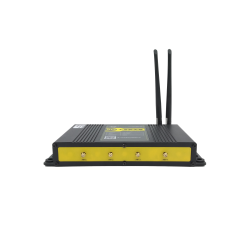
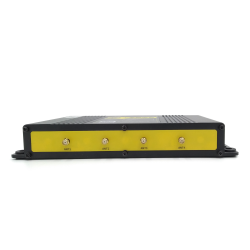
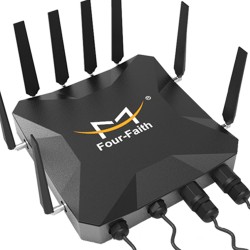
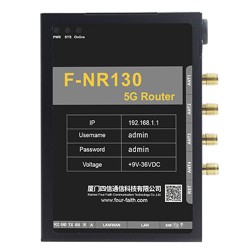
In outdoor and industrial CCTV deployments, it is worth looking at devices from the perspective of the operating scenario, not just the parameter table. The F-NR100, F-NR130, and F-NR200 models can be treated as three different answers to three different project needs.
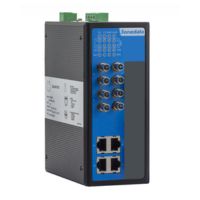
F-NR100 is a solution that fits well in facilities requiring greater port flexibility and more extensive cooperation with other devices in a control cabinet or aggregation point. If the monitoring system has to work together with additional network components, a local switch, a recorder, or devices communicating via serial interfaces, this variant may prove particularly practical.
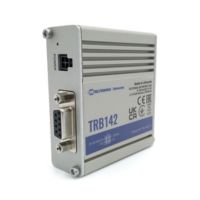
F-NR130 is a good fit for more compact deployments, where industrial-grade durability is still required, but without the need to expand the local network with a large number of ports. It is a sensible direction for smaller monitoring points, edge control cabinets, or installations where stability, environmental resistance, and network functions are more important than maximum interface expansion.
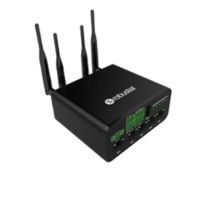
F-NR200 is, in turn, a very interesting choice where the device actually works outdoors and must withstand more demanding environmental conditions. It is in such applications that the advantage of a router designed for field deployment rather than typical indoor installation becomes most visible. For CCTV systems installed directly at the camera point or in an exposed location, this direction of selection is often the safest.
Importantly, none of these models should be judged solely by the label “best”. The best one is the one that most accurately matches the requirements of a specific installation: the number of devices, the operating environment, installation method, need for redundancy, remote access, type of power supply, and the target CCTV architecture.
Is it worth buying a 5G router now?
If the monitoring system is expected to operate over the long term, remain scalable, and not limit future changes within the facility, purchasing a 5G router is very often a technically justified decision. It is not only about 5G being able to provide higher performance than earlier mobile technologies. More importantly, a modern industrial router provides a greater reserve for the future: more expansion possibilities, better readiness for cooperation with new operator services, and more comfort in deployments that grow over time.
One thing should be emphasized, however: purchasing the hardware alone does not solve everything. The success of the project depends on the entire solution architecture. If the right router model is selected, the antenna installation is properly designed, secure remote access is planned, and camera transmission is correctly calculated, then 5G can become not only a sensible alternative to a wired link, but in fact the best option for outdoor monitoring.
Summary
The answer to the question “does a 5G router make sense?” is yes, if the monitoring system operates in the field, needs to be deployed quickly, requires flexibility, and cannot rely solely on wired infrastructure. The answer to the question “is it worth buying a 5G router?” is also yes, but only if you choose an industrial-grade device rather than a random consumer product. In CCTV systems, the quality of operation is determined not only by the transmission standard itself, but also by environmental resistance, installation method, access architecture, signal quality, and the preparation of the entire deployment.
Well-selected industrial routers 5G can significantly simplify the deployment of outdoor monitoring, shorten implementation time, improve service access, and increase system predictability. That is exactly why, in modern CCTV applications, people increasingly stop asking whether 5G is fashionable, and start asking whether it is simply the most logical choice for a given project.
Practical conclusion
If you want a stable connection in an outdoor CCTV application, router selection should start with the operating environment, network architecture, remote access method, and actual camera traffic, and only later move on to comparing maximum speeds. This is the approach that results in a deployment that works not only right after commissioning, but also after months of everyday operation.