





























Communication at an EV Charging Station: Modbus, Ethernet, RS-485, CAN and OCPP in Practice

An electric vehicle charging station is no longer just a simple device with power electronics and a charging socket. In practice, a modern EV charger works like a small industrial automation system: it measures energy, communicates with the operator’s backend, handles payments, reports statuses, performs diagnostics, manages power, works with a BMS or EMS system, and, in the case of DC chargers, exchanges data with power modules, controllers and safety systems. This is why communication in an EV charging station is one of the most important elements of the entire design.
A single charger may use Modbus RTU, Modbus TCP, RS-485, Ethernet, CAN, OCPP, MQTT, SNMP and local interfaces for configuration, service and diagnostics. Each of these standards has a different role. OCPP is typically responsible for communication between the charging station and the management system, Modbus is often used for exchanging data with energy meters and automation devices, RS-485 provides a simple serial bus, Ethernet builds the local communication network, and CAN is common in DC applications where fast data exchange between the controller and power-related devices is required.
From the perspective of a charger manufacturer, integrator or company developing its own charging system, the key question is: how should communication be designed so that the device is stable, serviceable and ready for integration with the customer’s infrastructure? The presence of a protocol alone is not enough. Hardware reliability, proper network separation, remote access, easy diagnostics, compatibility with higher-level systems and future scalability are equally important.
Table of contents
- Communication architecture in an EV charging station
- OCPP as backend communication
- Modbus RTU and Modbus TCP in EV chargers
- RS-485 in an EV charging station
- Industrial Ethernet and the charger’s local network
- CAN and CANopen in DC chargers
- Remote access, LTE, VPN and diagnostics
- Integration with BMS, EMS and dynamic load management
- Common design mistakes
- Which communication devices should be selected?
Communication architecture in an EV charging station
Several communication layers can be identified in a typical charging station. The first layer is communication between the vehicle and the charger. The second is communication between the charger and the operator’s management system. The third covers internal communication, meaning data exchange between the energy meter, controller, power modules, display, RFID module, payment terminal, router, switch and protection devices. The fourth layer is communication with an external building or energy management system, such as BMS, EMS, SCADA, photovoltaic system or energy storage system.
In a small AC charger, the architecture may be relatively simple: a charging controller, an energy meter over RS-485, an Ethernet or LTE communication module and an OCPP backend. In a DC charging station, the number of components increases. Power modules, cooling systems, auxiliary controllers, additional protection devices, HMI screens, temperature sensors, measurement systems and often a more advanced local network appear. The higher the power and the more public the station, the more important reliable data transmission becomes.
This is why charger manufacturers are increasingly using components known from industrial automation: industrial LTE routers, industrial Ethernet switches, Modbus RTU to Modbus TCP converters, protocol gateways, serial device servers and HMI panel computers. These devices are not just accessories. They are part of the infrastructure that determines whether the charger will be easy to service and stable in everyday operation.
OCPP as backend communication
OCPP, or Open Charge Point Protocol, is a protocol used for communication between a charging station and a central management system. In practice, OCPP is responsible for many functions visible to the operator: charging point status, starting and ending charging sessions, user authorization, energy reporting, error handling, remote commands, updates and smart charging features. For a charger manufacturer, OCPP is one of the key standards because it affects the device’s ability to work with different operator platforms.
However, OCPP does not replace all communication within the station. This is a common misunderstanding. OCPP describes communication at the charger-to-management-system level, but it does not automatically solve communication with the energy meter, power module, auxiliary controller, PV inverter, energy storage system, HMI panel or local BMS system. These tasks still require other protocols and interfaces such as Modbus RTU, Modbus TCP, CAN, Ethernet or RS-485.
In industrial projects, OCPP should therefore be treated as a higher-level layer, not as the only communication language of the charger. The operator’s backend may receive information via OCPP, but some of the data is generated lower in the system: in meters, sensors, controllers and communication modules. If this lower layer is poorly designed, the backend will receive incomplete, delayed or unstable data. That is why the selection of converters, switches, routers and edge devices has a direct impact on the quality of the entire charging system.
Modbus RTU and Modbus TCP in EV chargers
Modbus is one of the most common protocols in automation and power engineering. In EV charging stations, it appears primarily where data must be collected from energy meters, power analyzers, measurement modules, PLC controllers, EMS devices or load management systems. Modbus RTU usually operates over an RS-485 serial bus, while Modbus TCP uses Ethernet.
Modbus RTU is simple, cost-effective and well known among measurement device manufacturers. It works well when several devices are connected in one cabinet or in a small installation where communication runs over a short bus. Its limitations include the master-slave structure, transmission speed, sensitivity to wiring errors and the need for correct device addressing. In installations with more charging points or with a higher-level energy management system, moving to Modbus TCP may be more convenient.
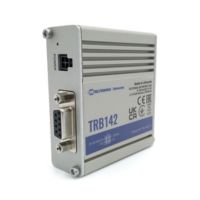
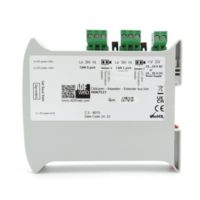
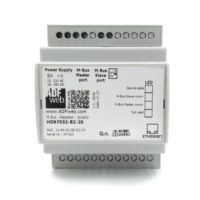
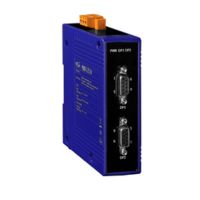
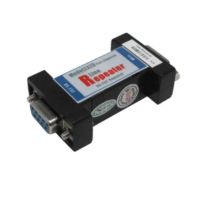
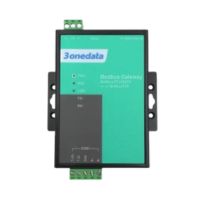
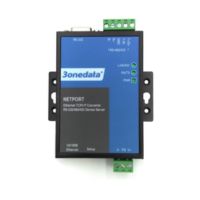
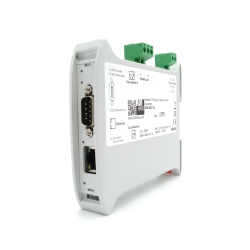
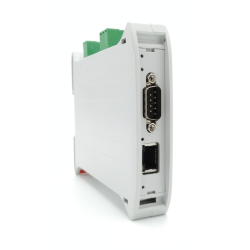
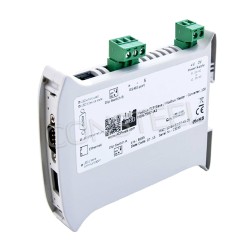
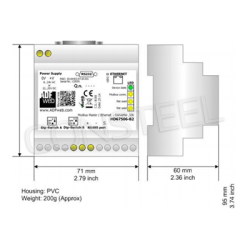
Modbus TCP allows data to be transferred to an Ethernet network and makes integration with SCADA, BMS, EMS or service applications easier. A typical example is an energy meter with an RS-485 output whose data must be available in a higher-level system over Ethernet. In this case, a Modbus RTU to Modbus TCP converter is used. A properly selected communication gateway makes it possible to collect data from multiple RTU devices and make it available via TCP without redesigning the entire measurement system.
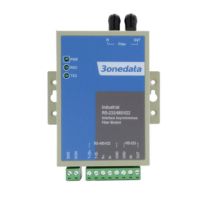
CONSTEEL Electronics offers industrial Modbus converters that can be used in exactly these types of applications. Example use cases include integrating energy meters, power quality analyzers or auxiliary devices in a charging station with a higher-level monitoring system. In an EV charger project, such a converter can operate as the element between the measurement layer and the local Ethernet network.
RS-485 in an EV charging station
RS-485 is not a protocol, but a physical layer standard. This means that it defines how the signal is transmitted, but not what data is being sent. Most often, Modbus RTU works over RS-485, although proprietary protocols from device manufacturers are also used. In charging stations, RS-485 is mainly used for communication with energy meters, measurement modules, sensors, auxiliary controllers and external devices.
The advantages of RS-485 include simplicity, noise immunity and the ability to operate over longer cable distances than classic serial interfaces. It is a good choice inside a charger cabinet, distribution board or installation where several measuring devices need to be connected to one controller. Problems appear when the bus is poorly installed: missing termination, cables routed next to high-current circuits, random shielding, duplicated device addresses or inconsistent transmission parameters.
In EV applications, RS-485 should be treated as a local layer, not as the final communication bus for the entire infrastructure. For one charger or one measurement point, it may be sufficient. For a larger charging hub, it is better to collect RS-485 data locally and then transfer it to the Ethernet network through a Modbus TCP gateway. This approach simplifies diagnostics and reduces problems related to long serial buses.
Industrial Ethernet and the charger’s local network
Ethernet is the foundation of modern communication in charging stations, especially where the device has to connect to a backend, local energy management system, payment terminal, camera, LTE router, HMI panel or diagnostic system. In a small charger, one Ethernet port may be enough. In a DC charging station or charging hub, a local network consisting of a switch, router and several end devices is usually required.
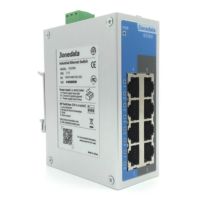
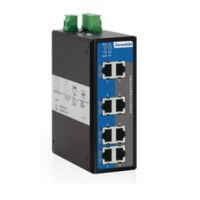
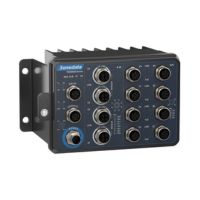
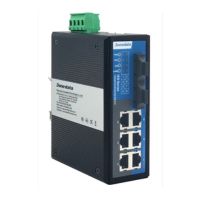
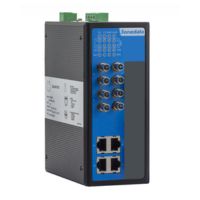
In outdoor or industrial environments, a switch should not be treated as an ordinary IT accessory. A switch in a charging station often operates in a cabinet exposed to temperature changes, electromagnetic interference, high currents, limited installation space and the need for many years of unattended operation. For these applications, it is worth selecting an industrial switch for an EV charger with DIN rail mounting, a wide operating temperature range, metal housing, redundant power supply, fiber optic ports or VLAN support.
Managed switches are useful in larger installations. They make it possible to segment the network, separate service traffic from operator communication, monitor ports, diagnose faults and control infrastructure more effectively. For a charger manufacturer, this is important because a communication failure does not always mean a failure of the power electronics. Sometimes the problem is a disconnected cable, a faulty port, an IP address conflict, an unstable modem or insufficient traffic separation.
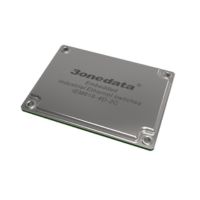
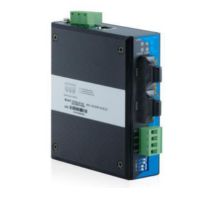
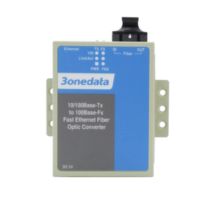
CONSTEEL Electronics supplies industrial switches, media converters and Ethernet solutions that can be used in EV applications, especially in outdoor stations, fleet parking areas, charging hubs, production plants and installations requiring stable communication between multiple devices.
CAN and CANopen in DC chargers
CAN is often used in applications where fast and robust communication between control devices is required. In DC chargers, it may appear in communication with power modules, control systems, auxiliary systems, sensors or components responsible for safe operation. Depending on the manufacturer’s architecture, classic CAN, CANopen or proprietary protocols used by power module suppliers may be implemented.
CAN does not perform the same function as OCPP. It is not usually used for communication with the operator’s backend, but rather for data exchange inside the device or between power system components. For example, the controller may read power module statuses, temperatures, alarms, available power, fault states or operating parameters. In a DC station, this type of communication directly affects charging stability and user safety.
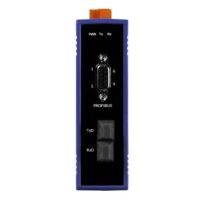
If data from CAN devices must be made available to a higher-level system, an appropriate protocol converter is required. In practice, this may involve converting CAN or CANopen to Modbus TCP, Modbus RTU, PROFINET or another standard used in the given architecture. This is particularly important in test benches, diagnostic systems and production applications where the charger manufacturer wants to collect data from multiple layers of the device in one place.
Remote access, LTE, VPN and diagnostics
One of the most important communication areas in EV charging stations is remote service. Every technician visit to a charger generates cost, and in the case of public stations it may also cause revenue loss and user dissatisfaction. That is why charger manufacturers and infrastructure operators should plan remote diagnostics, updates, log access, device restart and secure service access already at the design stage.
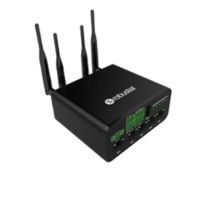
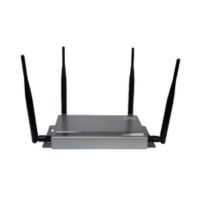
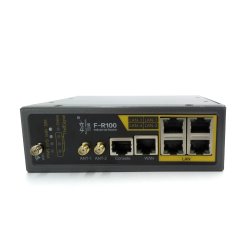
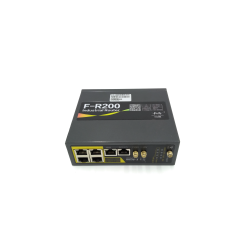
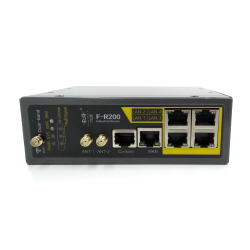
For this purpose, an LTE router for an EV charging station with VPN, dual SIM, automatic connection failover, backup WAN, firewall and connection monitoring functions is used. In practice, the router can act as the central communication point of the station: it connects the charger with the backend, enables service access, supports the VPN tunnel, provides communication with local devices and allows the connection status to be monitored.
In outdoor applications, dual SIM is particularly important. A charging station may operate in a location where one GSM operator has weak coverage, where temporary network overload occurs or where data transmission issues appear. A router capable of switching to a second SIM card reduces the risk of losing communication. In the case of DC stations, fleet parking areas and public infrastructure, this is often more important than maximum transmission speed itself.
Properly designed remote access should not mean an open network. Service access must be controlled, segmented and secured. It is worth separating backend communication, service traffic, local devices and possible peripherals such as a payment terminal, camera or Wi-Fi access point. This is where the functions of the router, managed switch and network security policy meet.
More and more EV chargers operate not as standalone devices, but as part of a larger energy system. In office buildings, production plants, logistics centers, hotels, shopping centers and company fleets, charging stations must cooperate with available power allocation, photovoltaics, energy storage, BMS, EMS or local automation. This is where dynamic load management becomes crucial.
Dynamic load management requires data. The system must know the current power consumption of the building, how much energy the chargers are using, what power is available, what the charging priorities are and whether there are grid connection limitations. This data usually comes from energy meters, power analyzers, inverters, PLC controllers or EMS systems. Very often it is made available via Modbus RTU, Modbus TCP, BACnet, MQTT or other automation protocols.
For charger manufacturers, this means the device should be prepared for integration with different environments. One customer may require communication over Modbus TCP, another may have a BACnet-based BMS, a third may expect data via MQTT, and another may require integration with an existing SCADA system. This is exactly where protocol converters, communication gateways and industrial network devices help connect the world of electromobility with building and industrial automation.
Common design mistakes in EV charger communication
The first mistake is assuming that communication ends with OCPP. OCPP is very important, but it does not solve communication with meters, sensors, power modules, routers, BMS or local energy management systems. If the charger’s internal communication is unstable, the backend will not fix the problem. It will only report incorrect or incomplete data.
The second mistake is using office-grade devices in an industrial environment. A low-cost switch or router may work correctly on a test bench, but it may not perform reliably in a charger cabinet where temperature fluctuations, interference, limited cooling and 24/7 operation are present. In EV infrastructure, industrial devices should be used wherever a communication failure means stopping the charging point.
The third mistake is the lack of network segmentation. Service devices, payment terminals, backend communication, cameras, HMI and local automation should not all operate in one network without control. Segmentation using VLAN, firewall rules, VPN and controlled service access reduces technical and security risks.
The fourth mistake is underestimating the RS-485 bus. Termination errors, incorrect cable selection, poor shielding, duplicated addresses and inconsistent transmission parameters may cause random problems that later look like meter or controller failures. In reality, the problem often lies in the physical communication layer.
The fifth mistake is the lack of a diagnostic plan. At the design stage, a charger manufacturer should already know how the service team will check connection status, router logs, Modbus device availability, Ethernet port status, LTE signal quality, IP addressing and error history. Without this, every field failure becomes longer and more expensive to solve.
Which communication devices should be selected for an EV charging station?
Device selection depends on the charger architecture and the role it has to play in the system. In a small AC charger, the most important elements may be a stable LTE router, communication with the meter over RS-485 and the ability to connect to the backend. In a DC station, additional Ethernet devices, communication with power modules, an HMI screen and more advanced diagnostics are required. In a charging hub, the local network, fiber optics, managed switches, VLAN segmentation and infrastructure monitoring become crucial.
In practice, the following device groups should be considered:
- Industrial LTE routers – for backend communication, remote service, VPN, dual SIM and backup WAN connection.
- Industrial Ethernet switches – for building a local network inside the charger, technical cabinet or charging hub.
- Managed switches – for VLAN segmentation, port monitoring, diagnostics and traffic separation.
- Modbus RTU to Modbus TCP converters – for integrating energy meters and RS-485 devices with an Ethernet network.
- Serial device servers – for remote access to RS-232 or RS-485 devices.
- Protocol gateways – for integrating chargers with BMS, EMS, SCADA or automation systems.
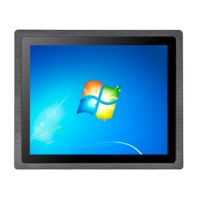
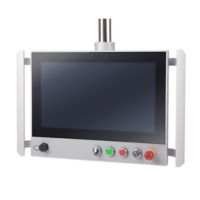
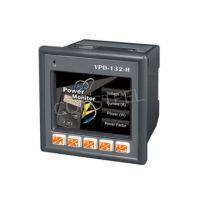
- HMI panel computers – for test benches, service, local visualization and operator applications.
- Media converters and fiber optic switches – for large parking areas, charging hubs and installations with longer communication distances.
CONSTEEL Electronics supplies devices that can support EV charger manufacturers, charging infrastructure integrators and companies building energy management systems. The offer includes industrial LTE routers, Ethernet switches, Modbus converters, protocol gateways, serial device servers, media converters and panel computers. This makes it possible to select a complete communication layer for a charger, test bench or entire charging hub.
Example communication scheme in an EV charging station
An example architecture may look as follows: the energy meter communicates with the controller or gateway via Modbus RTU over RS-485. The Modbus gateway makes the data available via Modbus TCP in the local Ethernet network. The industrial LTE router provides communication with the OCPP backend and secure service access via VPN. The industrial switch connects the router, controller, HMI, payment terminal and any additional devices. In a DC station, the controller may also communicate with power modules via CAN or CANopen. If the charger operates in a building, selected data can be transferred to a BMS or EMS system.
This architecture is more scalable than a system where all devices are randomly connected to one port or one bus. It separates local communication from backend communication, simplifies service and allows gradual expansion. If the customer later requires integration with an energy management system, an additional meter or a fiber optic network, the entire solution does not have to be redesigned from the beginning.
Communication as a competitive advantage for charger manufacturers
For the end user, the most important thing is that the charger works. For the operator, availability, billing, diagnostics and reduced service costs matter. For the manufacturer, even more is at stake: compatibility with backend systems, compliance with market requirements, integration with different installations, repeatable production and easier handling of service claims. All these areas are directly connected with communication.
Properly designed communication in an EV charging station is not an addition to the electrical design. It is an element that determines device scalability, data quality, security, service response time and integration possibilities. That is why charger manufacturers should define at the design stage which data should be available locally, which should go to the backend, which is required by BMS or EMS, and which should be available only to service teams.
Summary
Communication in an EV charging station includes much more than the OCPP protocol alone. OCPP is responsible for data exchange with the management system, but inside and around the charger, Modbus RTU, Modbus TCP, RS-485, Ethernet, CAN, MQTT, SNMP and other automation standards may also operate. Each of them has a different role and should be selected for a specific function: energy measurement, control, remote service, diagnostics, BMS integration or load management.
For EV charger manufacturers, the key is to design a communication layer that is stable, secure and scalable. In practice, this means using industrial LTE routers, Ethernet switches, protocol converters, Modbus gateways, serial device servers and HMI devices designed for technical environments.
If you design an EV charger, test bench, charging hub or a system for integrating chargers with BMS/EMS, communication should be analyzed at the very beginning of the project. Correct selection of a router, switch, Modbus gateway or protocol converter can shorten implementation time, simplify service and reduce integration problems in the field.
See related product categories:
Do you need to select communication devices for an EV charging station?
CONSTEEL Electronics helps select industrial LTE routers, Ethernet switches, Modbus converters, protocol gateways and panel computers for EV applications, automation, BMS, EMS and remote diagnostics systems.
-P1-250x250h.png "GW1101-1D(RS-485) - Industrial Modbus RTU / ASCII gateway to Modbus TCP")
-3-250x250w.png "GW1101-1D(RS-485) - Industrial Modbus RTU / ASCII gateway to Modbus TCP")
-DB-P(12-48VDC)-P-1-250x250h.png "GW1101-1DI(3IN1) Industrial Modbus RTU / ASCII gateway to Modbus TCP")
-DB-P(12-48VDC)-1-1-250x250h.png "GW1101-1DI(3IN1) Industrial Modbus RTU / ASCII gateway to Modbus TCP")